The short answer
Most turf failures are install failures, not product failures. A lasting install comes down to three things: a compacted, free-draining base, an edge that can't work loose, and seams that are glued and given time to cure. The turf on top is only as good as what holds it.
The base is the drainage system
Old grass and soil come out, two to three inches below the sod line, and the base is never built on topsoil. In Southwest Florida the base that works is screening sand, the same sand paver crews bed driveways on. It is wetted and compacted in lifts to a minimum of 95% Standard Proctor (ASTM D698), the Synthetic Turf Council's guideline for base compaction. Firm enough to hold its grade, still free-draining. Crushed gravel only comes into it when a yard needs deep fill, and even then it gets capped with screening sand.
The edge decides year five
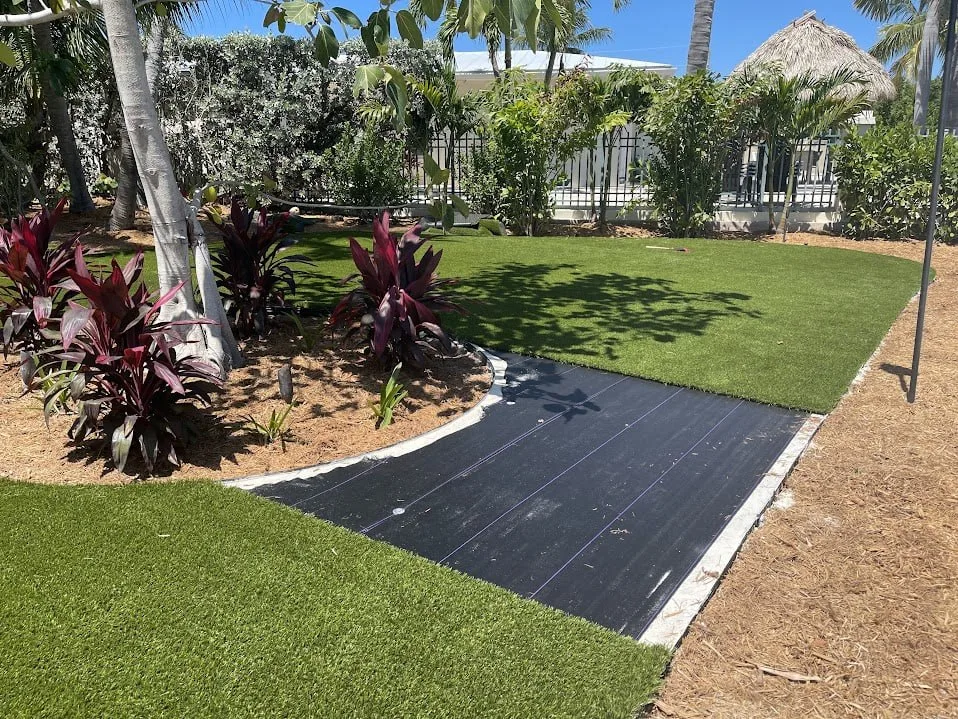
The industry default holds turf down with steel spikes driven through the lawn. Each spike is a single point that works loose as the turf expands and contracts. A poured concrete border, with the turf glued along the whole perimeter, removes the moving parts. Underneath the turf, nails and spikes still pin the weed barrier and the seam tape, which is where they belong.
What goes under the turf, top to bottom
| Layer | Job |
|---|---|
| Turf and infill | The surface. Infill weights it and holds the blades up |
| Woven weed barrier | Stops growth from below. Woven fabric is far stronger than pressed sheet |
| Screening-sand base | Compacted, graded and free-draining |
| Native soil | Left able to absorb water. It isn't pounded hard |
Seams and infill
Turf comes in rolls 15 feet wide, so most yards need seams. Every piece is laid with the blades leaning the same way (toward the house in a back yard, toward the street in a front yard), joined on seam tape, glued sparingly (excess glue seeps through and mats the blades) and weighted while it cures. Infill goes in at 1.5 to 2 pounds per square foot and is brushed against the grain until the blades stand.
Sprinklers and timing
Existing sprinkler heads inside the turf are capped and left in place, so the system stays intact and the yard stays reversible. Plan on about two days for every 1,000 square feet.
Questions in this section.
- How Artificial Turf Is Installed, Step by Step
- Concrete border vs spikes: how turf is supposed to be held down
- How are artificial turf seams joined, and why do they fail?
- Can turf go around a pool deck or over hardscape?
- Do I need a weed barrier under artificial turf? Where does it go?
- Does my yard need a French drain before turf goes in?
- How compacted should the base under turf be?
- How deep should the base be? How much digging is involved?
- How long does an installation take, and how messy is it?
- What base goes under turf — and why does a sand-only base fail?
- What happens to my sprinklers when turf is installed?
- Why do artificial turf installs fail in the first two years?
