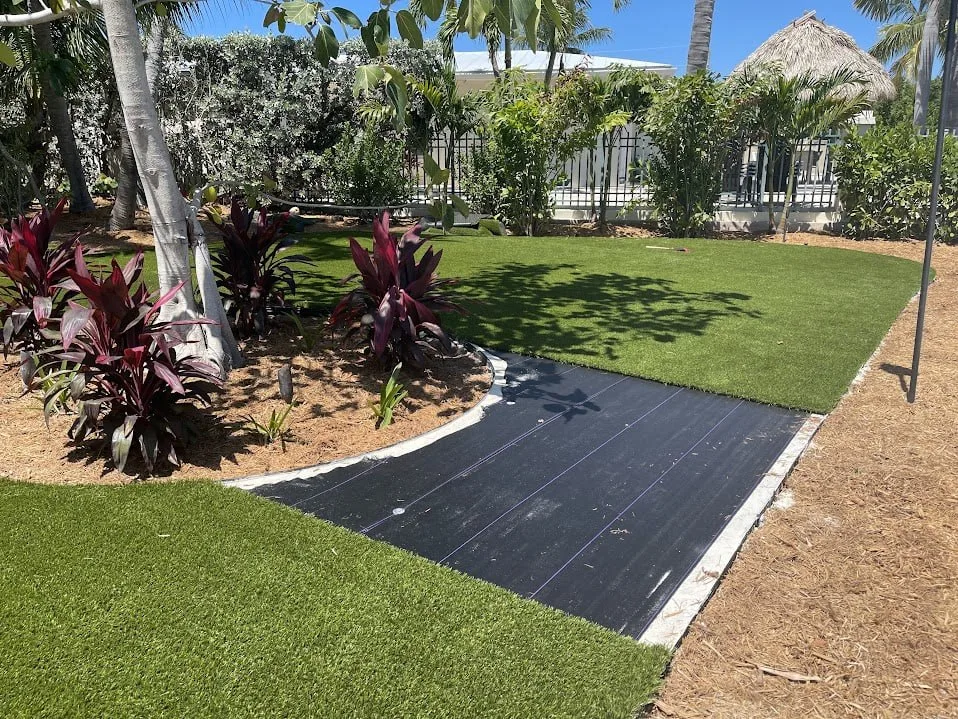
The short answer
Most residential installs take about two days per 1,000 square feet. The work runs in order — excavation and base first, turf, seams, and infill last — and it is real construction: expect equipment noise, sand deliveries, and a yard that stays off-limits until the final brush-out and walkthrough are done.
The short version
| Item | The number |
|---|---|
| Install time | ~2 days per 1,000 sq ft |
| Minimum install size | 1,000 sq ft |
| Scheduling | Installs typically scheduled within ~2 weeks |
| Excavation depth | ~2–3″ below the sod line |
| Screening-sand base | ~1 ton per 100 sq ft finished, minimum ~2″ compacted layer |
What the days actually look like
An install is a sequence, and the sequence is why it takes the time it takes. First the area is measured and planned around the 15-foot roll width, with cuts planned to minimize and hide seams. Then the old grass and soil come out — excavated roughly 2–3 inches below the sod line, because the base is never built on topsoil.
The base work is the slow, unglamorous middle: screening sand spread at roughly a ton per 100 square feet finished, wetted, and compacted in lifts to 95% Standard Proctor (ASTM D698) — AJ Turf's adopted written spec, aligned with Synthetic Turf Council guidance. In the field, the standard is simple to say: compact until the sand doesn't move. Edging outlines the area, a 3×3×3-inch concrete border is poured around the inside of the perimeter, and the woven weed barrier goes down on top of the compacted base.
Only then does anything green show up. Turf pieces are laid with every blade leaning the same direction — turf is directional — seams are joined on seam tape with glue, edges are glued to the concrete border, and infill is brushed in against the grain at 1.5–2 lb per square foot. Existing sprinkler heads are capped and left in place along the way, never ripped out.
How messy is it, honestly?
Messy in the ways any excavation job is messy. The old lawn comes out and gets hauled away. Sand arrives in bulk and gets spread, wetted, and plate-compacted — that means compactor noise and vibration during base work, and sand tracked where sand always gets tracked. The concrete border is wet work. During the job, the yard is a work site: pets and kids stay off it, and furniture, planters, and anything else in the footprint has to move before day one.
What it should not be is messy at the end. The finished job is judged on a short list: seams closed and invisible, the surface flat with no lumps or ripples, the turf bonded to the border along its whole length, infill spread evenly with no white spots where sand gathered and no dead spots it never reached, and the fibers brushed up and standing straight. If a yard still looks like a construction site at the walkthrough, the job isn't finished.
What stretches the timeline
Area is the main driver — the two-days-per-1,000-square-feet pace is the planning rule, and bigger yards take proportionally longer. Complexity is the other: more seams from an irregular footprint, deep fill that needs crushed gravel under the sand cap (gravel is used only where fill is measured in feet, and it is always capped with screening sand), and border work around pools, planters, and hard surfaces all add time. Weather is the third — see the Florida note below.
Florida note
Southwest Florida schedules installs around water in both directions. Seaming glue applied to a wet backing never forms its bond — seam work and afternoon summer showers do not mix, and a rainstorm can push gluing to the next dry window. Hurricane season (June 1–November 30) pauses installs around storms. None of that changes the pace of the work itself; it changes which days the work can happen, which is why the honest answer is a pace — about two days per 1,000 square feet — rather than a guaranteed calendar date for a yard nobody has measured yet.
The honest downside For those two days per 1,000 square feet, you don't have a yard — you have a job site. It's loud during excavation and compaction, the area is off-limits until the walkthrough, and rain can move the schedule. Anyone who tells you a full install is a quiet, tidy, few-hours affair is describing a different, shallower job than the one described above — usually one where the base work that takes the time was skipped.
The gotcha The one-day whole-yard promise. Speed claims almost always come out of the base: less excavation, less sand, less compaction, seams pressed down and never weighted while the glue sets. The yard photographs beautifully on day one. The failures that pace buys — ripples, washouts, seams opening — show up over the following seasons, and poor compaction washing out into divots is the failure pattern behind most of them. Ask any installer quoting you a suspiciously fast job one question: "Walk me through your base, lift by lift." The answer tells you where the time went.
How AJ Turf handles this
AJ Turf plans installs at about two days per 1,000 square feet, with installs typically scheduled within about two weeks. Installs start at a 1,000-square-foot minimum. The build follows the AJ Method in order: excavation 2–3 inches below the sod line, a screening-sand base compacted to 95% Standard Proctor, a woven weed barrier on top of the base, turf glued to a poured 3×3×3-inch concrete border — nails and spikes secure only the barrier and seam tape underneath, never through the turf — and infill at 1.5–2 lb per square foot. Most installs run $9–$15 per square foot depending on the turf and the site; the exact price comes only from the free onsite estimate, as one exact written price.
Questions people ask.
How long will a 1,000-square-foot yard take?
About two days at AJ Turf's standard pace. That's the minimum install size, and it's the unit the pace is quoted in — roughly two working days of excavation, base, border, turf, seams, and infill per 1,000 square feet.
Can I use the yard during the install?
No — treat it as a work site until the walkthrough. Excavation, compactors, wet concrete, and curing glue all need the area clear, and foot traffic on fresh seams or unfinished base undoes the work you're paying for.
What do I need to move before the crew arrives?
Everything in the install footprint: furniture, planters, toys, and anything stored on the grass. If it sits on the area being excavated, it has to go somewhere else for the duration of the job.
What happens if it rains mid-install?
The wet-sensitive steps wait. Glue on a wet backing doesn't bond, so seaming pauses until things dry; excavation and base work are scheduled around the weather rather than forced through it. In storm season, installs pause around hurricanes entirely.
Updated 2026-10-13
