The short answer
Most AJ Turf installs dig about 2 to 3 inches below the existing sod line, then build a compacted screening-sand base at least 2 inches thick — roughly 1 ton of sand per 100 square feet finished. Crushed gravel is only for deep fill measured in feet, and it is always capped with that same screening sand.
Why the dig is shallow — on purpose
Homeowners picture excavation as a construction trench. A turf base is not that. The dig has one job: remove the living layer — grass, roots, and topsoil — and make room for a built base that finishes at the right height against your edges, patios, and pool deck.
That is why the AJ Method's number is measured from the sod line, the surface your lawn sits at today. Digging about 2–3 inches below it removes the organic layer completely and leaves room for the base build without raising the finished yard above the hard surfaces it meets. The finished turf should land flush where it is supposed to land — not perched above a patio, not sunk below a border.
The depth is also a Florida answer. Generic national install advice built around thick crushed-rock road bases does not govern here. AJ Turf's standard base is screening sand — Florida paver-bedding sand — because that is what works in Southwest Florida's sandy ground over limestone. Depth follows the material and the doctrine, not a borrowed national recipe.
| Build element | AJ Turf standard |
|---|---|
| Excavation | About 2–3 inches below the sod line |
| Standard base | Screening sand, minimum 2-inch compacted layer |
| Finished sand quantity | About 1 ton per 100 sq ft in place |
| Compaction | 95% Standard Proctor (ASTM D698), Synthetic Turf Council guidance |
| Deep fill (only where needed) | Crushed gravel for feet of fill depth, always capped with screening sand |
| Never built on | Topsoil — the organic layer comes out, completely |
What the digging actually involves, step by step
Locates first. Before anything is dug, underground utilities are located — in Florida that means Sunshine 811, under Chapter 556, Florida Statutes. It is a standing step, not an optional courtesy.
Sod and soil come out. The old grass and soil are excavated to that 2–3 inches below the sod line, across the whole install area. Roots left behind rot and settle, which is why "remove the sod entirely" is a rule, not a preference: a base built over a dying root layer is a base with a settlement clock ticking under it.
Sprinklers are capped, not ripped out. Existing heads inside the turf area are capped and left in place. The system stays intact and reversible — the heads are simply taken out of service where turf now covers the ground.
The base is built, wetted, and compacted in lifts. Screening sand goes in at roughly 1 ton per 100 square feet finished, is wetted, and is compacted in lifts to 95% Standard Proctor (ASTM D698) — the Synthetic Turf Council benchmark AJ Turf adopted as its written spec — until the sand doesn't move. The finished compacted layer is a minimum of 2 inches.
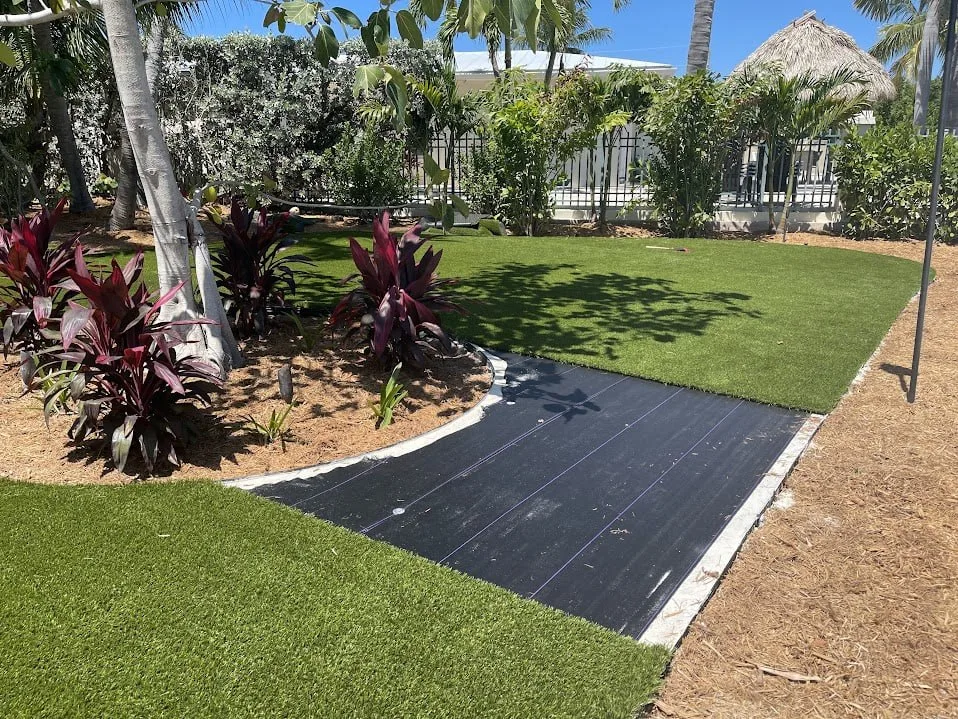
Then the top of the stack. A woven weed barrier goes over the whole area, on top of the compacted base, right under the turf. Edging and the poured 3×3×3-inch concrete border frame the perimeter; the turf itself is glued to that border.
When a job digs deeper
The 2–3 inch dig is the standard for a standard yard. Two situations change it:
- Deep fill. Where a yard needs to be raised or a low area built up by feet — not inches — crushed gravel does that heavy lifting, because sand alone is not a deep-fill material. The doctrine does not change: the gravel is always capped with the screening-sand base, so the turf still sits on the same finished stack.
- Grade and drainage corrections. A lot that holds water or grades toward the house needs its shape fixed while the ground is open. That work is scoped on site, because it depends on your lot — it is one reason the exact price of an install only comes from an onsite measurement, never a phone number.
What does not change the dig: product choice. A deeper base is not an upsell attached to a premium turf. The base is built to the doctrine; the turf sits on it.
How to think about the sand quantity
"About 1 ton per 100 square feet" is the finished, in-place quantity — what ends up compacted in your yard. The amount ordered for a job runs higher, because ordering covers waste, compaction, and spillage. If you are comparing quotes and one installer's material math looks dramatically lighter, ask whether their number is an in-place quantity or an order quantity — and more importantly, what compacted thickness is actually left under the turf when they are done. The spec that matters is the minimum 2-inch compacted layer in the ground.
Florida note
In Fort Myers, Cape Coral, Naples, Estero, Bonita Springs, Sanibel, and Lehigh Acres, the ground is sand over porous limestone, and aggregates that work in other states can lose structural integrity against that limestone bedrock — one more reason AJ Turf's base doctrine is screening sand, built around Florida's statewide synthetic turf standard (Rule 62-308.100), rather than an imported crushed-rock recipe. Shallow, complete excavation also matters here: Florida sod and root mass left under a base rots fast in heat and humidity, and the settlement shows up in the first year.
The honest downside Even a shallow dig is real excavation: sod and soil come out by the ton, get hauled, and the yard is a construction site until the base is in. Access matters — a fenced backyard with a narrow gate is slower work than an open lot, and that shows up in labor. The 2–3 inch standard also assumes a reasonably normal yard; lots needing feet of fill, regrading, or drainage correction are bigger jobs, and no honest installer can price that scope without standing in the yard.
The gotcha The bait runs in both directions. One installer skips the dig — turf laid over scalped grass and a dusting of sand, cheap because nothing was built — and the yard settles, wrinkles, and puddles within a season. Another sells depth you do not need, quoting a thick imported road-base build as if Florida sand required it. Ask every bidder the same three questions: "How far below my sod line do you dig? What is the base material? And what compacted thickness is left when you finish?" AJ Turf's answers are on this page, in writing.
How AJ Turf handles this
The AJ Method's base doctrine is fixed, so every quote is built from the same stack: excavate about 2–3 inches below the sod line, never building on topsoil; screening-sand base at about 1 ton per 100 square feet finished, minimum 2 inches compacted, wetted and compacted in lifts to 95% Standard Proctor (ASTM D698) per Synthetic Turf Council guidance; crushed gravel only for feet of fill, always sand-capped; woven weed barrier on top of the base; turf glued to a 3×3×3-inch concrete border with seams on tape and glue — nails and spikes only underneath, securing the barrier and seam tape, never through the turf. Pile leans toward the house in backyards and toward the street in front yards. Sprinklers are capped, never ripped out.
Most installs run $9–$15 per square foot depending on the turf and the site, with the exact price set only by a free onsite quote — where dig depth, fill needs, and grade are measured on your lot. Installs are a minimum of 1,000 square feet and typically scheduled within two weeks. Deposits are 30% to schedule, 35% on the first day on site, and 35% on completion, always non-refundable. Turf carries the manufacturer's warranty for the product you choose — 8, 16, or 25 years, UV stability and strength only, prorated, non-transferable — plus AJ Turf's 1-year labor warranty. Repairs are a separate lane: free onsite assessment, no minimum job size. And if your HOA needs an application, AJ Turf prepares and submits it on your behalf.
Questions people ask.
Is 2–3 inches of digging really enough?
For a standard yard, yes — because the purpose of the dig is to remove the living sod-and-topsoil layer and seat the built base at the right finished height, not to bury the yard in aggregate. The base that goes back in is a minimum 2-inch compacted screening-sand layer built to a written compaction spec. Depth beyond what the build needs adds cost, not performance.
What happens to all the sod and dirt you dig out?
It is removed from the install area as part of the excavation — the base cannot be built over it. The full scope, including haul-out and how your yard is left, is set in the written quote from the onsite measurement, so there is no surprise line item after the dig starts.
My yard is low and holds water. Will you dig deeper?
Possibly — but depth alone is not the fix for a wet yard. Low areas needing real build-up get gravel for the feet of fill, always capped with screening sand, and grade or drainage problems are corrected while the ground is open. That scope is exactly what the free onsite quote is for: it is assessed on your lot, not guessed from a map.
Why sand and not the crushed-rock base I see in install videos?
Because those videos are mostly not Florida. AJ Turf's doctrine is screening sand — Florida paver-bedding sand — compacted to a written spec. In Southwest Florida, crushed aggregates can lose structural integrity against the porous limestone underneath, and generic national road-base advice does not govern a Florida install. Gravel still has a job here: deep fill, always sand-capped.
Updated 2026-10-13
