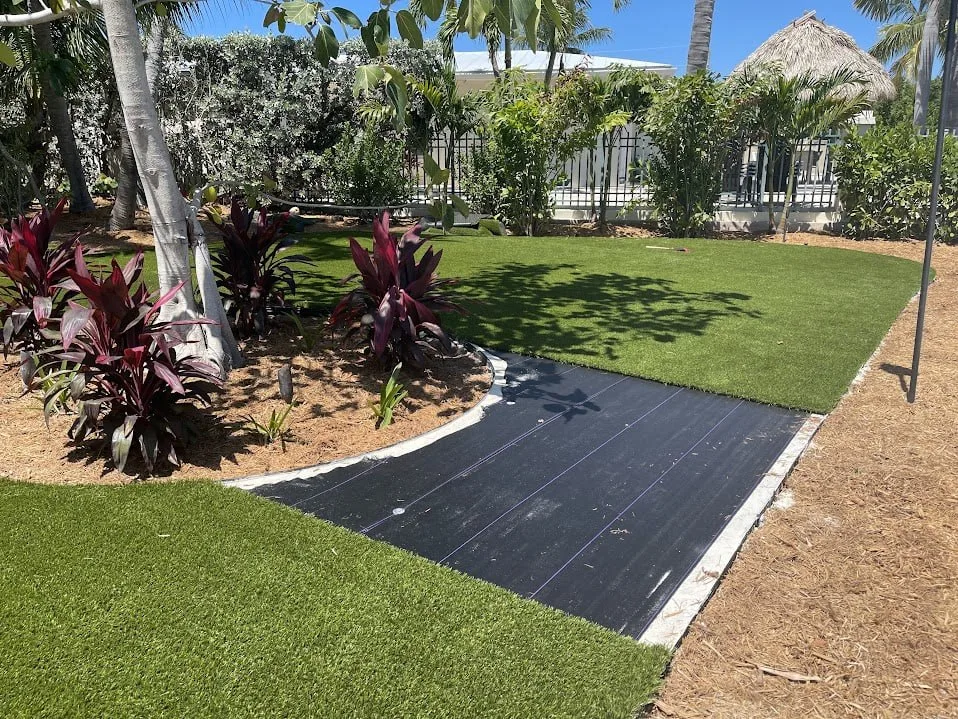
The short answer
Not every Southwest Florida yard needs a French drain before turf, but flat lots that already puddle — especially in Cape Coral — often do. Turf and its base drain straight down fast; the drain's job is moving that water sideways to daylight. The test is your yard now: standing water after rain means design drainage in.
Two different drainage jobs
Most drainage confusion comes from mixing up two separate jobs. The first is vertical: rain has to pass down through the turf backing and into the base. A permeable backing over a permeable base handles that well. The second job is lateral: once the water is in the base, it has to travel sideways — to daylight, a swale, or a drain — and leave. On a lot with grade, gravity does that job for free. On a flat Southwest Florida lot, gravity has almost nothing to work with, and that is the gap a French drain fills: a perforated pipe in the base that collects the water and carries it to a pop-up emitter or swale.
This is why "the turf drains at X inches per hour" never settles the question. The backing is rarely the bottleneck. The base — and where the base can send the water — is the design.
The grade math underneath every install
The base under turf is graded to slope 1–2% away from structures and pool decks. That pitch is the drainage design on a typical lot: water enters the base, follows the grade, and exits at the low edge. Around pools, the deck and coping line decide where water wants to go, and turf butted to a pool deck must pitch away from the pool — pitch it wrong and every rain sheets dirty water into the water you swim in.
Where 1–2% of working grade cannot be had — a dead-flat lot, a yard hemmed in by fences, patios, and neighboring grades, or ground that simply holds water — grading alone cannot finish the job. That is French drain territory: not an upsell category, a geometry answer.
The signs your yard is a drain yard
| What you see now | What it means for the turf design |
|---|---|
| Standing water or puddles that last more than about 30 minutes after rain | The lot already cannot move water sideways — design a French drain in before turf, not after |
| A flat lot with no visible slope to a swale, ditch, or street | No gravity path exists; the base needs a piped exit |
| Ground that stays soft or spongy well after storms | Water-retention-prone soil behavior — subsurface drainage belongs in the plan |
| Water sheeting toward the house, patio, or pool today | The grade is working against you; turf must be pitched away, and a drain may be what makes that possible |
| A yard that drains cleanly today and dries quickly | Working grade already exists — most of these yards do not need a drain |
The honest test happens before anyone sells you anything: how does the yard behave in rain right now? Turf does not fix a yard that cannot drain — it covers it. Whatever your lot does with water today, it will keep doing under the turf, out of sight, until it shows up as puddling, algae slick on the pile, or odor that rinsing will not fix because water is trapped underneath feeding bacteria in the base.
What happens if you skip it and needed one
The failure signature is predictable: puddling that lasts more than 30 minutes after rain, then the secondary problems — algae film making the pile slippery in the damp spots, debris and uneven infill further impeding drainage over time, and in pet yards an odor problem that no surface treatment keeps up with. At that point the fix is no longer a design decision; it is a repair — opening the install back up to regrade the base or add the drain that geometry required on day one. Adding drainage before turf is a line item. Adding it after is a project.
Florida note
Southwest Florida is where this question matters most. Our lots are famously flat — much of Cape Coral has almost no natural fall — the water table is high, the soil is sand over porous limestone, and summer rain arrives in downpours rather than drizzles. Florida's statewide synthetic turf standard is also a drainage standard: our installs are built around Florida's statewide synthetic turf standard (Rule 62-308.100), which requires the turf system to stay permeable, the subgrade to be prepared for positive drainage, and the finished install to create no pooling and no increased stormwater runoff to neighboring properties. On canal-front lots, the 10-foot setback from the water shapes where turf — and its drainage — can go. A flat, canal-front Cape Coral yard is exactly the yard where this conversation belongs at the quote, not after the first storm.
The honest downside A French drain is real work and real money added to the project — excavation, perforated pipe, and an outlet that has to actually reach daylight. It also is not magic: a drain with nowhere to discharge is a buried pipe, not a solution, and on some lots the honest answer is regrading, a swale connection, or both alongside the pipe. And if your yard already drains well, a drain buys you nothing — we would rather tell you that than sell you a trench you do not need.
The gotcha Drainage gets sold from both dishonest directions. One installer puts a French drain in every quote whether the lot needs it or not — a padded line item you cannot verify once it is buried. The next one never mentions drainage at all, quotes lower, and leaves you with a yard that puddles after every storm. The tell is the same in both cases: nobody looked at how your yard handles water today. Ask any installer one question before turf: "Where does the water in my base go — show me the path." If the answer is just a backing drainage number, you have not been given a drainage design.
How AJ Turf handles this
Drainage is assessed at the free onsite estimate, before the price is written — we look at the lot's grade, where water stands today, and where it can legitimately exit. Our base is screening sand — about 1 ton per 100 square feet finished, minimum 2-inch compacted layer — excavated 2–3 inches below the sod line and compacted to 95% Standard Proctor (ASTM D698) per Synthetic Turf Council guidance, graded for positive drainage away from the house and pool. On flat, water-holding lots, we design a French drain into the base from the start, run to a pop-up emitter or swale. The finished stack stays permeable all the way down: turf, woven weed barrier on top of the compacted base, the sand base itself — and no fabric under the base to trap water. Sprinkler heads in the turf area are capped and left in place, never ripped out.
Questions people ask.
How can I tell if my yard needs a French drain before turf?
Watch it in rain now. If water stands for more than about 30 minutes after rain, if the lot has no visible slope toward a swale or street, or if the ground stays spongy long after storms, your yard is telling you it cannot move water sideways — that is the job a French drain does. A yard that already drains and dries quickly usually does not need one.
Can't the turf's drainage rate handle heavy rain on its own?
The backing draining vertically is only half the system. Water that passes through the turf still has to travel sideways through the base and out of the yard. On flat Southwest Florida lots, that lateral path — grade, or a drain where grade runs out — is what decides whether the yard puddles.
Is a French drain standard on every AJ Turf install?
No — it is designed in where the lot needs it: flat, flood-prone, or water-holding yards, which describes a lot of Cape Coral. Putting one in every quote regardless of the lot would be padding. The assessment happens at the free onsite estimate, before your exact price is written.
What happens if we skip the drain and the yard puddles later?
Puddling past about 30 minutes after rain is the signature, and it tends to bring algae slick and, in pet yards, odor that cleaning cannot fix because water is trapped under the turf. The later fix — regrading the base or adding the drain — means opening the install back up, which is why we settle it at design time.
Updated 2026-10-13
