The short answer
A sand-only base fails when it is thin, uncompacted, or laid over dirt — it shifts, washes, and telegraphs lumps. Done right, screening sand is the correct Florida base: excavated 2–3 inches below the sod line, built to at least 2 inches compacted, and compacted to 95% Standard Proctor.
The distinction this whole page hangs on
"Sand-only base" describes two completely different jobs, and confusing them is how homeowners get talked into the wrong one — in both directions.
The failing version is a shortcut: a dusting of loose sand thrown over the existing dirt or old sod line, never wetted, never compacted in lifts, with no real depth and no border to hold it in. Pure loose sand shifts underfoot, washes toward the low corner in the first heavy rain, and telegraphs every lump and dip straight through the turf within a season or two. That is the #1 shortcut in failed cheap installs, and it deserves its reputation.
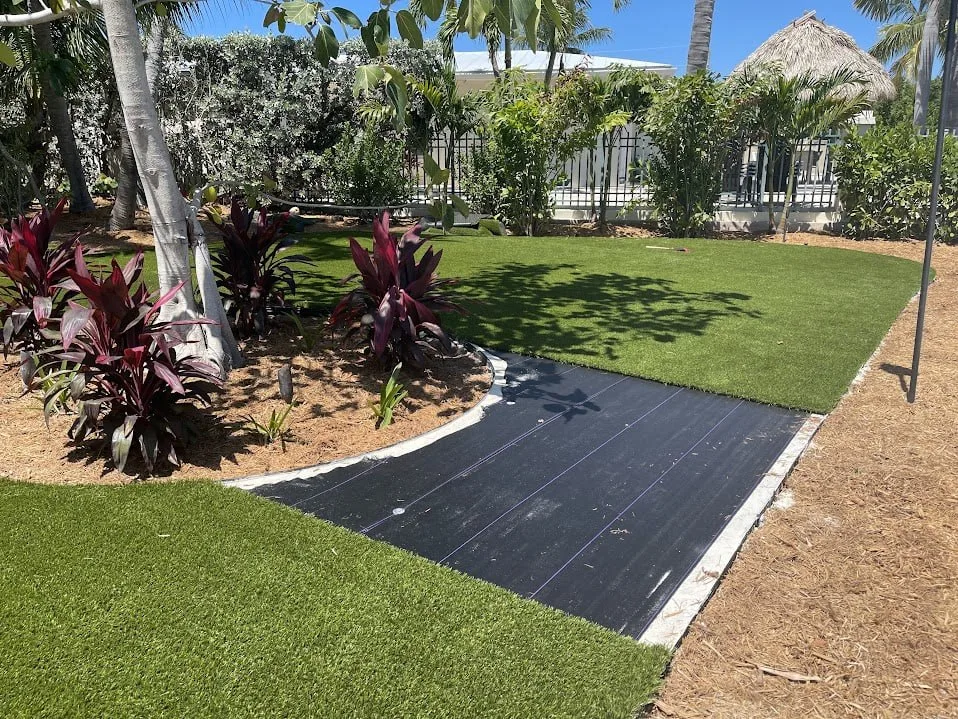
The working version is a system: the yard is excavated, the screening sand is built to a real compacted depth, wetted and compacted until it doesn't move, capped and edged so it can't migrate, and finished with a woven weed barrier on top, right under the turf. Same material name — "sand" — opposite result. The material was never the problem. The missing depth, compaction, and containment were.
The Florida base, layer by layer
| Layer | AJ Turf spec | Why it's there |
|---|---|---|
| Excavation | Dig out old grass and soil ~2–3″ below the sod line; never build the base on topsoil | Roots and topsoil left behind rot, settle, and move |
| Deep fill (only when needed) | Crushed gravel ONLY where the fill depth is measured in feet — and always capped with screening sand | Gravel is a bulk fill tool, not the standard Florida base layer |
| Screening-sand base | Minimum ~2″ compacted layer; finished quantity ≈1 ton per 100 sq ft | The working surface the turf is actually built on |
| Compaction | 95% Standard Proctor (ASTM D698), wetted and compacted in lifts — "compact until the sand doesn't move" | AJ Turf's adopted written spec, aligned with Synthetic Turf Council guidance |
| Woven weed barrier | Woven — not pressed/nonwoven — on TOP of the compacted base, right under the turf | Strength and tensile strength far above cheap nonwoven barrier; it is the only fabric in the system |
| Perimeter | Turf glued to a poured 3×3×3″ concrete border | Contains the sand, anchors the edges, keeps the base from migrating out |
Two things this stack deliberately does not include: there is no geotextile under the base — the woven barrier on top of the sand is the only fabric — and there is no crushed-gravel layer on a standard job.
Why the "you need crushed gravel" advice is wrong for typical Florida
Most national turf content is written for clay and road-base country, and it says, flatly, that turf must sit on inches of crushed gravel or Class 2 road base — and that sand is always wrong. Homeowners in Fort Myers read that and assume a Florida installer using sand is cutting a corner. It's the other way around.
Southwest Florida soil is sand over limestone, with a high water table. Sand is both the local blessing and the local curse: it drains freely, but it migrates and it doesn't compact like clay. Separately, aggregates like crushed gravel and granite can lose structural integrity in Florida because of the state's porous limestone bedrock. Hauling in a national-spec gravel base doesn't fix either problem — it imports a solution to a problem Florida doesn't have.
What Florida sand actually needs is what the generic advice skips: real depth, wetting, compaction in lifts to a written standard, and a poured border that physically keeps the sand where it was compacted. Crushed gravel still has exactly one job in our method: when a yard needs feet of vertical fill — not inches — gravel does the bulk work, and it is always capped with screening sand so the turf never sits on it directly.
How a bad sand base actually fails
- Washout and dips. Uncompacted sand moves with water. Poor compaction leads to washout, and washout leads to divots — the warning that shows up in every repair call on a cheap install.
- Lumps telegraphed through. The shape of your base is the shape of your finished yard. A base that was never screeded and compacted flat prints every irregularity through the pile.
- Migration at the edges. Sand with no border and no containment walks out at the perimeter — and as the base thins at the edges, the edges are exactly where the turf starts lifting.
- Puddling. A flat or negatively graded base holds water under the turf. Puddling that lasts more than 30 minutes after rain is a base-and-grade diagnosis, not a turf diagnosis — trapped water under turf also feeds the bacteria behind pet odor.
The base is the drainage system. The turf's backing drains vertically and fast; it's the base that has to move that water sideways, on a positive grade away from structures and pool decks, to daylight or a drain. On flat Southwest Florida lots, that grade has to be designed in — it doesn't exist by accident.
Florida note
Florida's statewide synthetic turf standard (Rule 62-308.100) is built around permeability: the turf system goes on a permeable backing over a pervious subgrade, prepared for positive drainage, and the soil beneath the subgrade must not be compacted so hard that percolation is killed. AJ Turf's 95% Standard Proctor spec applies to the screening-sand base above the native soil — compact the base hard, per the Synthetic Turf Council guidance we adopted; don't seal the native ground under it. Our installs are built around Florida's statewide synthetic turf standard (Rule 62-308.100). One Florida-specific caution: sprinklers inside the turf area are capped and left in place, never ripped out — the system stays intact and reversible.
The honest downside A proper screening-sand base is not the cheapest way to fill a hole, and we'll say so: excavation, hauling in roughly a ton of sand per 100 square feet, wetting and compacting in lifts, and pouring a full concrete perimeter costs real money and real time compared to a loose sand dusting. And sand has an honest limitation — it migrates. That's precisely why the AJ Method contains it with edging and a glued concrete border instead of pretending the material behaves like road base. If your yard needs feet of fill, sand alone isn't the answer either; that's the one case where crushed gravel comes in, sand-capped.
The gotcha Watch for the bait in both directions. One installer sells you a thin layer of loose sand over dirt and calls it a base — that's the failure this page is about. Another sells you a national-spec crushed-gravel base at a premium because "sand always fails," without mentioning that the advice was written for clay country. Ask either of them the same three questions: "How deep is the finished base? What compaction standard do you build to — in writing? And what contains the base at the edges?" A real base has three numeric, checkable answers. Vague ones are how yards get rebuilt in year two.
How AJ Turf handles this
The AJ Method builds the base the same way on every job: excavate ~2–3 inches below the sod line, never on topsoil; build the screening-sand base to a minimum ~2-inch compacted layer (about 1 ton per 100 sq ft finished), wetted and compacted in lifts to 95% Standard Proctor (ASTM D698); use crushed gravel only for deep fill measured in feet, always capped with screening sand; lay the woven weed barrier on top of the compacted base, right under the turf; and pour the 3×3×3″ concrete border the turf is glued to. Seams are joined on tape with glue, nails and spikes secure only the barrier and seam tape underneath — never through the turf — and existing sprinkler heads are capped, not ripped out. Installs start at 1,000 sq ft and are typically scheduled within two weeks; most run $9–$15 per square foot, with the exact price set only by a free onsite quote. Terms are 30% to schedule, 35% at install start, and 35% on completion — always non-refundable. The turf carries the manufacturer's warranty for the product you choose (8, 16, or 25 years depending on the product, covering UV stability and strength only, prorated and non-transferable), and the installation carries AJ Turf's 1-year labor warranty.
Questions people ask.
Is a sand base ever the right choice in Florida?
Yes — it's our standard base. Screening sand done right (real depth, wetted, compacted to 95% Standard Proctor, contained by a concrete border) is the correct base for typical Southwest Florida yards. What fails is loose, thin, uncompacted sand over dirt — a shortcut wearing the same name.
When does a turf base actually need crushed gravel?
When the job needs feet of vertical fill, not inches. In the AJ Method, crushed gravel does that bulk-fill work only, and it is always capped with screening sand — the turf never sits directly on gravel.
How deep should the base under artificial turf be?
In our method: excavation ~2–3 inches below the sod line, and a finished screening-sand layer of at least ~2 inches compacted — about 1 ton of sand per 100 square feet in place. Depth without compaction isn't enough; both numbers travel together.
Does compacting the base that hard hurt drainage?
Not when it's done in the right layer. The 95% Standard Proctor spec applies to the screening-sand base; the native soil beneath it is not over-compacted, so percolation through the ground is preserved. The system — permeable backing, permeable base, positive grade — is what drains the yard.
How can I tell if my existing turf has a base problem?
The field signs: puddles still standing 30 minutes after rain, dips or divots that weren't there at install, lumps printing through the surface, and edges thinning or lifting as sand migrates out. Those are base symptoms, and they're what a free onsite assessment checks first.
Updated 2026-10-13
