The short answer
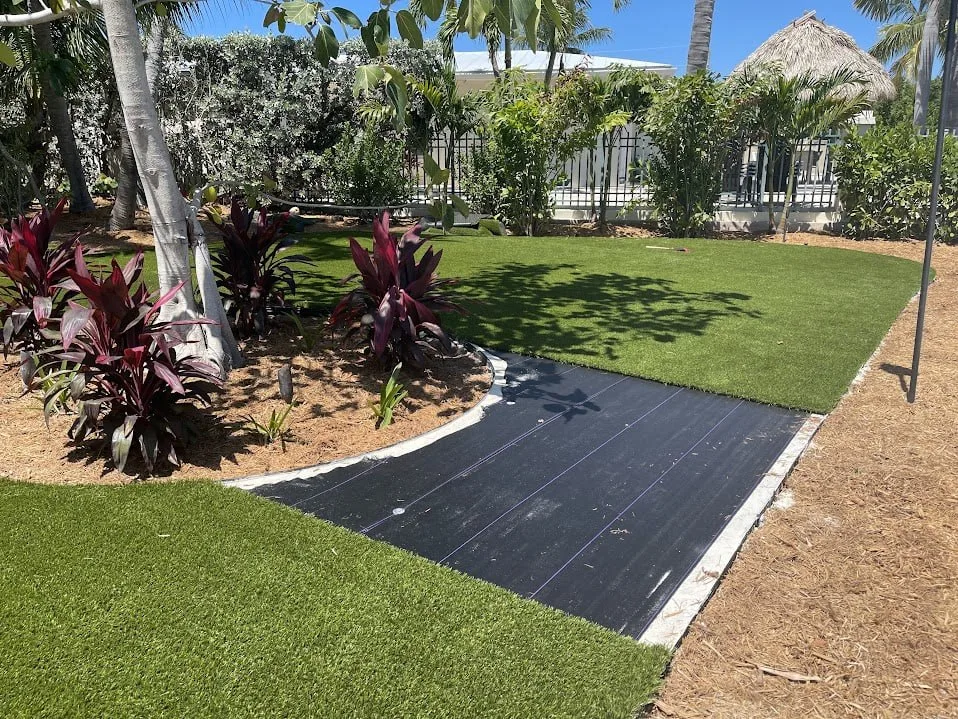
Yes — and where it goes matters more than whether you have one. In the AJ Method the woven weed barrier sits on top of the compacted screening-sand base, right under the turf. There is no second geotextile under the base. Woven, not cheap pressed fabric, is the whole point: strength and staying power.
What the barrier is actually doing up there
Most people picture a weed barrier as a sheet on the dirt, with everything piled on top of it. That picture is why so many installs get this layer wrong.
In the AJ Turf stack, the barrier's job sits at the top of the base, directly under the turf:
- It is the last line between the base below and the turf above — a continuous woven sheet covering the whole install area, so growth pushing up from the ground meets fabric, not a gap.
- It helps hold the finished surface together as a system: the turf above it is glued to a concrete border at the perimeter, and the barrier underneath is secured in place — with turf spikes or galvanized nails with washers — as part of that anchored stack, all of it under the turf.
- It stays water-permeable. A barrier that sealed the system would defeat the drainage the base was built for; woven construction blocks from below while letting water pass through to the base.
The full stack, top to bottom, is short enough to say in one breath: turf, then the woven weed barrier, then the compacted screening-sand base, then your native soil. One fabric in the whole method — this one.
| Layer (top to bottom) | What it is |
|---|---|
| Turf | Glued to the 3×3×3-inch concrete border at the perimeter |
| Woven weed barrier | On top of the compacted base, right under the turf — the only fabric in the build |
| Screening-sand base | Minimum 2-inch compacted layer, 95% Standard Proctor (ASTM D698) |
| Native soil | Left able to percolate — not over-compacted |
| Under the base | No geotextile. Ruled out. |
Why there is no second fabric under the base
You will find install advice — including an earlier draft of our own audit — recommending a second woven geotextile separation layer on the excavated ground, under the base. AJ Turf considered it and ruled it out, deliberately. The woven barrier on top of the base is the only fabric in the Method.
The reasoning is practical. The barrier's work — the separation and weed-blocking that has to happen at the turf — happens where the turf is. A second sheet buried under two inches of compacted sand adds a layer the system does not need to do that work, and "more layers" is not the same as a better build. Every layer in the AJ Method has a named job. The under-base geotextile did not earn one, so it is not in the stack — and any AJ Turf quote you get will show exactly one fabric, in exactly one place.
Woven vs. pressed: the difference that decides whether it lasts
Not all "weed barrier" is the same product, and this is where cheap installs cut the corner you cannot see after the turf is down.
AJ Turf's barrier is woven construction — flat tapes woven warp and weft into a fabric. It is chosen for strength, tensile strength, and effectiveness, which are far above the cheap pressed (nonwoven) barrier sold in big-box rolls — the kind that tears during install, degrades, and stops functioning as a barrier while still being listed on the quote as "weed barrier included."
That is the whole comparison, and we make it as a positive claim about our own build: woven is what we install, on every job, including pet jobs, because a barrier is a structural layer in our stack — not a line item to value-engineer after the contract is signed. In the field, the barrier is identified by its woven construction; there is no brand name on the roll to sell you, because landscape-supply woven barrier is sold unbranded — the construction is the spec.
One honest limit, stated plainly: a barrier blocks growth coming up from the ground. It does not stop seeds that blow in and germinate in the infill on top of the turf — those weeds are rooted in the surface, not the soil, and they are a brushing-and-cleanup matter, not a barrier failure.
How the barrier is secured — without a single spike through your turf
The barrier is pinned down with turf spikes or 4–6 inch galvanized nails with washers, and the seam tape under your turf seams is pinned the same way. All of that hardware lives underneath the turf. No spike or nail ever goes through the turf itself — the turf is anchored by being glued to the concrete border around its full perimeter. When we say "no spikes," we mean no spikes through the turf; the fasteners under it are part of doing the job right, and spikes through turf are the shortcut that damages turf and works loose into a hazard.
Florida note
Florida grows weeds the way other states grow lawns — year-round, aggressively, in Fort Myers, Cape Coral, Naples, Estero, Bonita Springs, Sanibel, and Lehigh Acres alike. A barrier layer that tears or degrades is a barrier with an expiration date inside a system built to last the life of the turf. The woven barrier also has to live inside a permeable system: AJ Turf builds around Florida's statewide synthetic turf standard (Rule 62-308.100), which requires turf on permeable backing over a pervious subgrade — a woven, water-passing barrier fits that system; a plastic sheet would break it.
The honest downside A weed barrier is not a force field. It stops ground-up growth; it does nothing about airborne seeds germinating in the infill, and a homeowner who expects zero weeds of any kind forever will be disappointed by physics. The barrier also cannot be inspected or replaced without lifting the turf — which is precisely why the cheap pressed version is such a bad bet: the layer you can least afford to have fail is the one you will never see again after install day.
The gotcha The bait is the line item itself: "weed barrier included." It tells you nothing — not the construction, not the placement. Pressed nonwoven fabric thrown on bare dirt under an unbuilt base checks the same box on a quote as a woven barrier installed on top of a compacted spec base. Ask two questions: "Is it woven or pressed?" and "Does it go on top of the base, under the turf — or under everything?" If the installer cannot answer both without hesitating, the barrier on your quote is a checkbox, not a layer.
How AJ Turf handles this
The AJ Method's stack never varies: dig about 2–3 inches below the sod line; screening-sand base — about 1 ton per 100 square feet finished, minimum 2 inches compacted — wetted and compacted in lifts to 95% Standard Proctor (ASTM D698), the Synthetic Turf Council benchmark we adopted; woven weed barrier over the whole area on top of that base, secured underneath the turf; then turf seamed on tape and glue, edges glued to a 3×3×3-inch concrete border whose glue carries a 15-year warranty. No under-base geotextile, no spikes through the turf, no pressed-fabric substitution. Pile leans toward the house in the backyard and toward the street in the front yard; sprinkler heads are capped and left in place.
Most installs run $9–$15 per square foot depending on the turf and the site; the exact price comes only from a free onsite quote. Installs are a minimum of 1,000 square feet, typically scheduled within two weeks, with deposits at 30% to schedule, 35% on the first day on site, and 35% on completion — always non-refundable. Turf carries the manufacturer's warranty for the product you choose — 8, 16, or 25 years, UV stability and strength only, prorated, non-transferable — plus AJ Turf's 1-year labor warranty. Need the barrier question answered for an existing yard instead? Repairs start with a free onsite assessment and have no minimum job size. And AJ Turf prepares and submits your HOA application on your behalf.
Questions people ask.
Will I still get weeds with a barrier in place?
You can get surface weeds — seeds that blow in and root in the infill on top of the turf. The barrier's job is the other direction: stopping growth from the soil below from coming up through the system. Surface weeds pull easily and are handled with brushing and cleanup; ground-up growth through a failed barrier is a construction problem.
My installer put the barrier under the base instead. Is that wrong?
It is a different stack than the AJ Method — and in our build, yes, it is the wrong place. The ruled AJ position puts the one fabric on top of the compacted base, right under the turf, and no geotextile under the base at all. If your turf is performing, do not tear it up over layer order alone; if weeds are coming through or the surface is failing, that is a repair assessment.
Can I see or check the barrier after my turf is installed?
Not without lifting the turf — which is the point of asking about construction and placement before you sign. On an AJ Turf install, the barrier is part of the documented method: woven construction, on top of the base, over the whole install area, on every job including pet jobs.
Does the barrier block drainage?
No — not the woven barrier in the AJ stack. It is water-permeable by construction, so water passes through it into the compacted base below, the way Florida's permeable-system standard requires. An impermeable plastic sheet would be a drainage problem; that is not what is installed.
Updated 2026-10-13
