The short answer
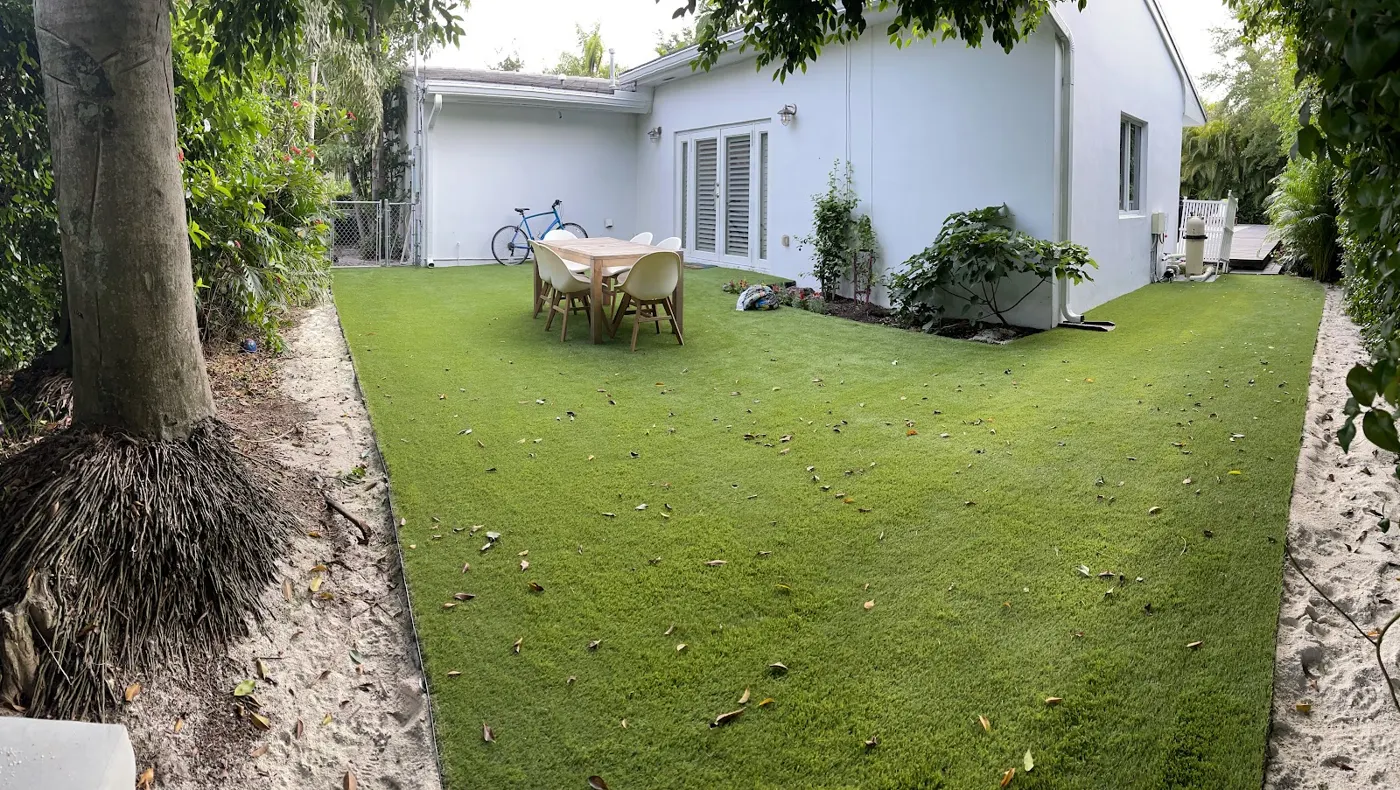
A cheap install cuts what you cannot see on day one: base depth and compaction, the woven weed barrier, seam tape and full glue, a real perimeter border, enough infill, and the right infill for pets. The yard photographs the same — then seams open, edges lift, and odor arrives within two years.
Why the cuts are always underground
An installed yard has exactly one visible layer — the grass — and everything that determines whether it lasts is underneath or at the edges. That asymmetry is the whole economics of the cheap install: the turf itself has to look right at the walkthrough, because that's what the homeowner can judge. The base depth, the compaction, the barrier, the seam work, the border, and the infill load are all invisible by the time the crew leaves. So that's where the money comes out.
The result also photographs beautifully. The cuts don't announce themselves at install — they announce themselves on a schedule: pet odor by month three, seams in the first year, wrinkles and edge lift after the first summer, dips after the first rainy season. By then the comparison that mattered — quote against quote, line by line — is a year in the past.
The cut list
| What's cut | What the proper version looks like | When the cut shows up |
|---|---|---|
| Base depth & compaction | Excavation ~2–3″ below the sod line; screening-sand base, min ~2″ compacted layer (~1 ton per 100 sq ft); wetted, compacted in lifts to 95% Standard Proctor (ASTM D698) | Dips, divots, and puddles after the first rainy season |
| The weed barrier | A woven barrier — chosen for strength and tensile strength — over the whole area, on top of the compacted base | Weeds from below; a barrier that tears and fails early |
| Seam work | Seam tape under every seam, full glue spread, weighted through the cure | Open or peaking seams within the first year |
| The perimeter border | A poured 3×3×3″ concrete border, turf glued to it along its whole length (glue with a 15-year warranty) | Wrinkles, creeping panels, and lifting edges after the first summer |
| Infill quantity | 1.5–2 lb per sq ft, spread evenly — no white spots, no dead spots | Matted lanes, moving panels, wrinkles that grow at midday |
| The pet layer | An odor-active infill layer (zeolite or antimicrobial coated sand) over the ballast | A "pet yard" that smells by month three |
| The finish work | All panels laid in one pile direction; seams planned around the roll width; sprinklers capped, not ripped out | Color bands at seams from day one; damaged irrigation discovered later |
Cut 1 — the base. This is the biggest and least visible saving. Less excavation, less sand hauled in, no wetting, a couple of passes with a plate compactor — or none — and the line item shrinks. Research and repair experience agree on what loose, thin sand does: it shifts, washes, and telegraphs lumps within a season or two. It's the #1 shortcut in failed cheap installs, and it's doubly expensive because wear from an inadequate sub-base is an exclusion in the manufacturer's warranty (more on that in the gotcha below).
Cut 2 — the barrier. The cheap version is a thin, pressed nonwoven barrier from a big-box shelf — or, on pet jobs, no barrier at all, following the generic advice that barrier isn't recommended with pets. The proper version is a woven barrier on every job, pets included: woven construction is chosen because its strength and tensile strength are far above the cheap nonwoven product.
Cut 3 — the seams. Tape skipped, glue starved or striped instead of fully spread, seams hand-pressed instead of weighted through the cure — sometimes, on a wet afternoon, glued to a damp backing because the schedule said so. Every one of those is a seam that opens on schedule. Seaming is inch-by-inch work, and inch-by-inch work is exactly what a cheap quote can't afford.
Cut 4 — the border. Spikes are fast and cheap; a poured concrete border is neither. So the cheap install spikes the perimeter through the turf and calls it secured. Spikes are point loads in sand: they work loose under thermal cycling and foot traffic, the perimeter creeps, the panel wrinkles, the edges lift — and a spike that comes out of the ground is an injury risk. The border is where "no spikes through the turf — glued to concrete instead" stops being a preference and becomes the whole ballgame.
Cut 5 — the infill. Infill is bought by the bag and brushed in by the hour, so the cheap install goes light and uneven: under the 1.5 lb per square foot floor, gathered in white spots in one area and missing in another. Under-infilled turf mats, moves, and wrinkles — infill is what gives the fibers the structure to stand.
Cut 6 — the pet layer. The most cynical cut, because it's sold as included. The quote says "pet turf," and the infill is plain silica — which holds urine against the backing and has no odor mechanism at all. The proper pet job carries an odor-active layer: zeolite that traps ammonium before it becomes ammonia, or an antimicrobial coated sand that urine rinses through.
Cut 7 — the finish and the leftovers. Panels laid without regard to pile direction (backyard pile should lean toward the house, front yard toward the street), seams landing wherever the cuts fell instead of planned around the 15-ft roll width, and sprinkler heads ripped out instead of capped — destroying a system the homeowner may want back. None of it costs much to do right. All of it costs the homeowner later.
Florida note
In Southwest Florida the cut list gets audited by the climate, fast. Summer downpours grade the base and find every uncompacted lift; daily heat cycles work every spike and under-cured seam; humidity runs pet-odor chemistry at full speed. The market's complaint record matches the physics: seams in year one, wrinkles and edge lift after the first summer, odor by month three, and then the final cut — the installer who goes unreachable when the callbacks start. A cheap install in Florida isn't a slower version of a good install. It's the same failures, sooner.
The honest downside Doing none of this is cut means the install genuinely costs more — excavation, a ton of sand per 100 square feet, compaction to a written standard, a woven barrier, a poured concrete border, full seam work, and a full infill load are real material and real labor. Most AJ Turf installs run $9–$15 per square foot, and we're not the cheapest quote you'll get; on pure first price, a cut install wins. What we can tell you honestly is what the second price looks like: the repair or rebuild you'll price in year two, against a yard that should have run the life of the turf. And some cuts have a worse downside than repair cost — the next box explains the warranty problem.
The gotcha The cheapest install can cost you the warranty on the expensive part. Manufacturer turf warranties cover the product maintaining UV stability and strength — and they exclude faulty installation and wear or abrasion from an inadequate sub-base. Read that again: the two things a cheap quote cuts first are the two things that can void your claim on the turf itself. It is necessary to have proper installation if a warranty claim is ever filed. So the "savings" aren't just a quality gamble — they're the homeowner self-insuring the product. Ask any low bidder: "If I file a warranty claim in year three, will your base and seam work pass the manufacturer's review?" Watch the answer.
How AJ Turf handles this
We publish our method so it can be checked against this list, line by line: dig ~2–3 inches below the sod line, never on topsoil; screening-sand base at a minimum ~2-inch compacted layer, wetted and compacted to 95% Standard Proctor (ASTM D698) per Synthetic Turf Council guidance; woven weed barrier on top of the base on every job, pets included; seams on tape with a full glue spread; a poured 3×3×3″ concrete border with the turf glued to it — nails and spikes secure only the barrier and seam tape underneath, never through the turf; infill at 1.5–2 lb per square foot, spread evenly and brushed in; on pet jobs, a named odor layer — ZeoFill (zeolite) at rates scaled to the dog, or Envirofill by Motz (antimicrobial coated sand) at 1.5–2 lb per square foot; pile direction matched on every panel; sprinkler heads capped and left in place. The quote behind that method is one exact price from a free onsite measurement, with payments staged 30% to schedule, 35% at install start, 35% on completion — always non-refundable — and AJ Turf's 1-year labor warranty next to the manufacturer's warranty for the product you choose (8, 16, or 25 years, UV stability and strength only, prorated, non-transferable). Installs start at 1,000 sq ft and are typically scheduled within two weeks. We also prepare and submit your HOA application on your behalf.
Questions people ask.
If both yards look identical at the walkthrough, how do I compare before signing?
Compare the quotes line by line on the invisible items: base depth and the compaction standard in writing, barrier type (woven, and on every job?), how seams are joined, how the perimeter is secured, and the infill type and rate. A quote that won't specify those is telling you where its margin lives.
Is a spike-secured perimeter really that bad?
In Florida sand, yes — it's a schedule, not a risk. Spikes are point loads; thermal cycling and foot traffic work them loose, the perimeter creeps, and you get wrinkles and lifting edges, usually starting the first summer. A lifted spike is also a barefoot injury risk. The durable alternative is a continuous bonded edge — turf glued to a concrete border.
Can't I just add the pet infill layer later if the yard starts to smell?
Sometimes — if the smell is in the infill, swapping it for zeolite works. But if the install also cut the backing quality and the base drainage, odor moves into the base, and by then the fix is construction, not a bag of infill. The pet layer costs least when it's spec'd in the original quote.
Why do cheap installers go unreachable when things fail?
Because the math never included the callback. Warranty and repair labor on a cut install has no margin to fund it, so the follow-up doesn't happen — it's one of the most consistent complaint themes in this market. It's why who answers the phone in year two belongs on your quote checklist next to price.
What should a complete quote actually name?
The exact product (with both its face weight and total weight — a quote showing only one number is hiding the comparison), the base spec, the barrier, the seam method, the perimeter method, the infill type and rate, the staged payments, and the labor warranty in writing. If it's not named, assume it's cut.
Updated 2026-10-13
