The short answer
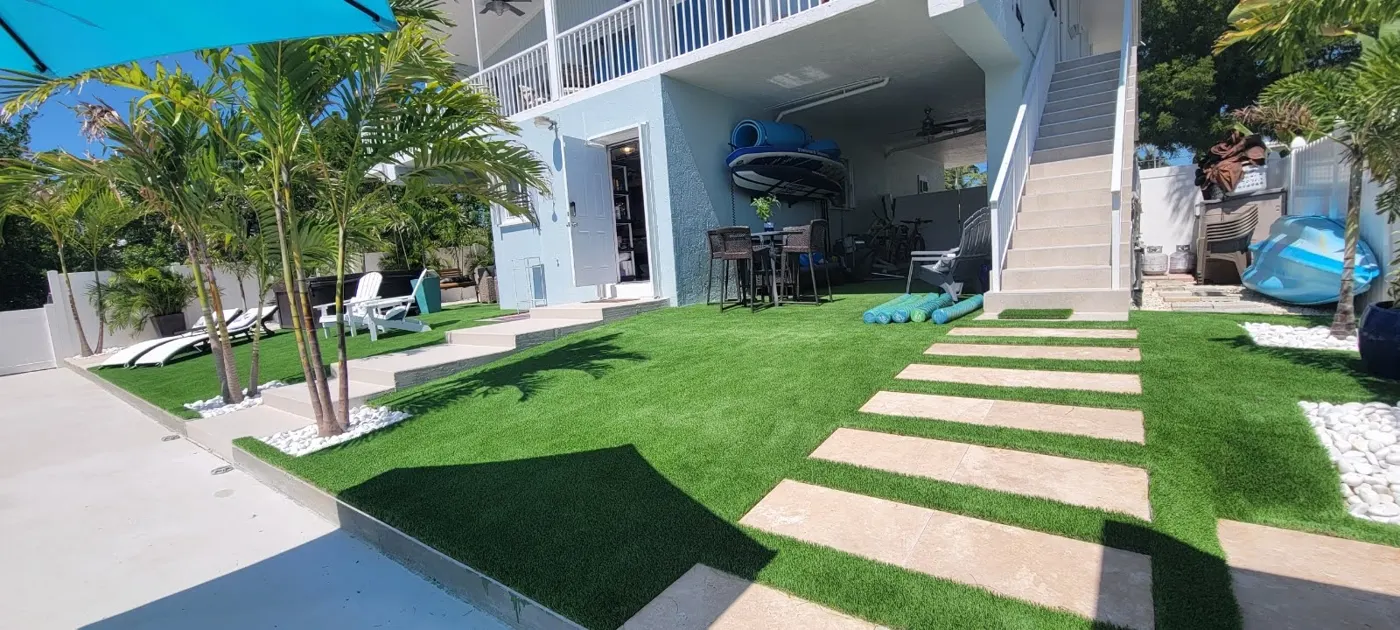
Turf looks fake and shiny when uniform blades reflect light in one direction, the color is a flat green, there is no thatch at the base, and the pile is sparse enough to show the black backing. Real-looking turf breaks light with shaped blades, mixes blade and thatch colors, and carries enough face weight to look like grass, not plastic.
The five realism traits
| Trait | Looks fake | Looks real |
|---|---|---|
| Blade shape | Flat blade alone, or one shape throughout | Shaped blades (C, W, Omega, Diamond among them) that fold light in different directions |
| Light behavior | One hard sheen across the whole lawn | Light dispersed by folded profiles — a W/Wave fold, for example, reflects light for a natural look |
| Color | A single uniform green | Mixed greens in the blades plus tan/gold thatch at the base |
| Density | Sparse pile; black backing shows between stitch rows | Enough face weight that you see yarn, not backing |
| Direction | Panels laid with pile running different ways | Every piece laid the same direction, leaning toward the main viewpoint |
Shine is a light problem
Plastic shines when a flat surface reflects light evenly, the way a ribbon does. A blade with no fold does exactly that — which is why blade cross-section is functional, not marketing garnish. The shapes exist to manage light and structure:
- Flat blades give the most realistic look and the softest feel — but they are the least durable, and on their own, in one uniform color, they are the classic shiny-lawn recipe. They are often blended with W and Omega shapes to fix that.
- C blades are the backyard workhorse for heavy traffic, but they reflect more light than folded profiles.
- W / Wave blades use a folded profile to disperse light (and heat), which reads as natural instead of glossy.
- Omega blades balance softness and durability and mirror the look and feel of natural grass under traffic; Diamond blades give a silky texture and natural look at low-to-medium traffic.
No shape is simply "best." Blade shape is a trade-off dial — resilience against softness against heat against realism — and realistic products blend shapes and yarns instead of betting on one.
Fakeness is a density and color problem
Shine is only half the tell. The other half is what your eye finds under the green:
Density. Face weight — the ounces of yarn per square yard above the backing — is how much grass is actually in the grass. On a sparse product, the stitch rows spread apart and you can see black backing between them. That glimpse of backing is one of the strongest "fake" signals there is, and no amount of shine control fixes it.
Thatch. Real lawns have a tan, tangled base layer. Turf with short, curly tan/gold thatch at the base copies it — visual depth, color contrast, and backing cover in one layer. Turf without it is green blades on a black sheet.
Color. Living Florida grass is never one color: new growth, older blades, and the thatch layer all differ. Products built from a single green yarn read as a carpet. Mixed blade colors plus thatch tones read as a lawn.
Direction. Turf is directional, and pile direction changes the sheen. Two panels laid with the grain running different ways read as two different colors in the same yard — a top "cheap install" tell even when the product itself is good. Every piece on a proper install faces the same way: on AJ Turf installs, backyard pile leans toward the house and front-yard pile leans toward the street, so the main viewpoint sees the best face.
Florida note
Southwest Florida light is brutal and direct for most of the year — the exact condition that exposes flat, uniform yarn. A sample that looks fine under showroom lighting can glow like plastic at noon in Fort Myers. Judge samples outside, in full sun, next to a real lawn if you can. The comparison that matters is also local: your neighbors' St. Augustine has a visible thatch layer and mixed color, and your turf will be judged against it from the sidewalk.
The honest downside The most realistic products are a compromise, not a clean win. The softest, most natural-looking flat blade is also the least durable; chasing realism alone can buy you a lawn that mats in a traffic lane. Real-looking turf also costs more — density, blended yarns, and thatch are material, and material is money. And even the best product can't fully hide being turf up close: it will never have the variation, smell, or imperfections of a living lawn.
The gotcha Watch how the weights are quoted. Every product has two numbers: face weight (the yarn — what you're actually paying for) and total weight (face + backing + coatings, always bigger). The industry drifted toward quoting total weight because the bigger number "seems better," and a heavy backing can make a sparse, shiny turf "weigh" like a dense one. A quote showing only total weight is hiding the comparison. AJ Turf's rule: both numbers, always. Verify the product on the truck against the quote — both numbers, not one.
How AJ Turf handles this
We pick products on the realism traits above — shaped and blended yarns, thatch in the lawn products, mixed color — and we publish both weights on every quote so density is never a guessing game. Install is the other half of the look: all pieces laid in one direction (backyards leaning toward the house, front yards toward the street), seams joined on tape with glue and weighted while they cure, edges glued to a poured 3×3×3″ concrete border instead of spiked through the turf, and infill brushed in against the grain at 1.5–2 lb per square foot so the pile stands instead of lying flat and glossy. Most installs run $9–$15 per square foot, exact price only from the free onsite quote; 1,000 sq ft minimum, typically scheduled within about two weeks, 30/35/35 non-refundable payments. Turf carries the manufacturer's warranty for the product you choose (8, 16, or 25 years, UV stability and strength only, prorated, non-transferable), plus AJ Turf's 1-year labor warranty. We serve Fort Myers, Cape Coral, Naples, Estero, Bonita Springs, Sanibel, and Lehigh Acres.
Questions people ask.
Why does my neighbor's turf shine in stripes?
Stripes usually mean direction, not product: panels laid with the pile running different ways reflect light differently and read as alternating light and dark bands. It's an install error — the fix is lifting and re-laying the offending panel in the correct direction.
Does taller turf look more real?
Not by itself. Pile height without density looks like sparse green string, and taller pile mats faster under traffic and holds more heat. Realism comes from face weight, thatch, color mix, and blade shape working together.
Can you fix shiny turf after it's installed?
Brushing against the grain and correcting low infill can reduce a flat, glossy lay, but shine built into the product — flat uniform yarn, single color, no thatch — can't be renovated away. That's why the sample check happens before the install, in sunlight.
What should I look for in a sample to avoid the fake look?
Part the pile: you should see tan/gold thatch at the base, not black backing. Check for more than one green in the blades. Flex the blades — shaped yarn shouldn't crease like a flat ribbon. Then ask for the face weight, not just the total.
Updated 2026-10-13
