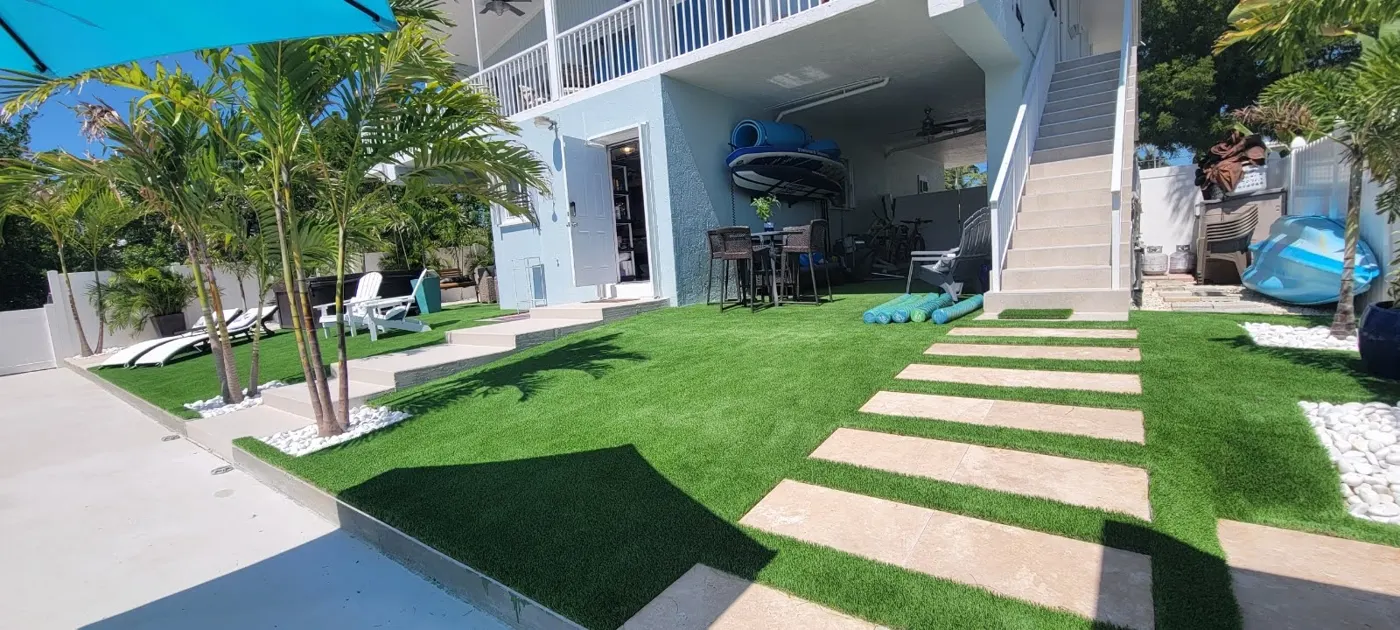
The short answer
Good artificial turf should drain faster than Florida rain can fall — at least enough that water never sits on the surface. In lab testing, the products we work with measured 25.4 inches per hour with infill and 19.1 inches per hour without it. In your yard, though, the base underneath — not the turf — decides real drainage.
What those lab numbers actually mean
A drainage rate in inches per hour is a lab measurement: how much water passes through a sample of turf, under controlled test conditions, in one hour. It tells you the turf itself is not a plastic sheet. Water moves through the backing and out of the pile.
Two lab measurements from tested product frame the honest range:
| Test condition | Lab drainage measurement |
|---|---|
| Turf with infill installed | 25.4 in/hr |
| Turf without infill | 19.1 in/hr |
Read those numbers the right way. They are measurements on specific tested products in a lab — not a promise that every yard with that turf will clear water at exactly that speed on a specific afternoon. Once turf is installed over a real base, in real soil, with real grading, the system drains at the speed of its slowest layer. That layer is almost never the turf.
The base is the bottleneck
This is the point most turf marketing skips. The backing drains vertically, and it drains fast. Then the water arrives in the base — and the base has to move it somewhere: down into the soil below, or sideways along a grade to daylight or a drain.
If the base is built from a free-draining material, graded for positive drainage, and not choked with fines, the system keeps up. If the base is flat, clogged, compacted into a pan, or laid over soil that cannot percolate, water backs up under turf that tested beautifully in a lab. The turf gets blamed for a base failure.
That is also why two yards with the same turf can behave completely differently in the same storm. One was built as a drainage system. The other was laid over whatever was already there.
What good drainage looks like in a real yard
- Water disappears through the surface during rain instead of sheeting across it or pooling on top.
- No puddle is still standing well after the rain stops. Puddling that lasts is a grading or base diagnosis, not a "wait longer" situation.
- The yard dries evenly — no permanently soggy low spot that stays slick, grows algae, or starts to smell.
- Water moves away from the house, pool deck, and hard surfaces, not toward them.
Debris and uneven, migrated infill can also impede drainage over time, which is why drainage is partly a maintenance topic, not only an install topic. Leaves and organic matter left to break down in the pile work against the system you paid for.
Drainage, backing, and the system view
Backings differ. Some drain through punched holes in a coated backing; high-flow designs drain through the whole surface. Either architecture can work — what matters is whether the backing, the infill, and the base underneath were chosen and built as one system.
Infill plays a role too. The lab pair above — faster with infill than without it in that test — is a reminder that test conditions change results, and single headline numbers stripped of their conditions are not comparable from one product sheet to the next. Ask what was tested, with what infill, and under what method before you compare two drainage claims.
Florida note
Southwest Florida rain does not fall gently. Summer storms drop water fast, lots in Fort Myers, Cape Coral, Naples, Estero, Bonita Springs, Sanibel, and Lehigh Acres are often flat, and the water table is high. A drainage number that is adequate in a dry climate on a sloped lot can be irrelevant here if the base has nowhere to send the water. AJ Turf builds around Florida's statewide synthetic turf standard (Rule 62-308.100) — including positive drainage and keeping runoff off neighboring properties — because in Florida, drainage design is the install, not an accessory to it.
The honest downside A high lab drainage number does not guarantee a dry yard. Lab samples are clean, new, flat, and tested in isolation; your yard has soil, grade, debris, aging infill, and Florida storms. Turf over a bad base will puddle no matter what the spec sheet says, and fixing that later means lifting the turf and rebuilding what is under it — construction, not a surface treatment. Drainage also degrades if the surface is never brushed or cleared: a neglected system drains worse in year five than it did on install day.
The gotcha The bait is the biggest drainage number on the page. Sellers quote flow-through figures measured with no infill, on a bare sample, and present them as your yard's drainage rate. Then the install goes over a flat, fine-clogged base and puddles in the first storm. Ask any installer two questions: "Was that number tested with infill or without it?" and "What in my base is going to move the water once it is through the turf?" The second answer is the one that decides whether your yard drains.
How AJ Turf handles this
AJ Turf treats the base as the drainage system. The standard build digs about 2–3 inches below the sod line, lays a screening-sand base — about 1 ton per 100 square feet finished, with a minimum 2-inch compacted layer — wet and compacted in lifts to 95% Standard Proctor (ASTM D698), the Synthetic Turf Council's guidance, graded for positive drainage. Crushed gravel is used only where feet of fill depth are needed, and it is always capped with screening sand. On top of the compacted base goes a woven weed barrier — permeable, so it does not seal the system — and then the turf. Existing sprinkler heads in the turf area are capped and left in place, never ripped out.
Most AJ Turf installs run $9–$15 per square foot depending on the turf and the site; the exact price comes only from a free onsite quote, where drainage — grade, low spots, and where the water will go — is assessed on your actual lot. Installs are a minimum of 1,000 square feet and are typically scheduled within two weeks. Deposits are 30% to schedule, 35% on the first day on site, and 35% on completion, always non-refundable.
Questions people ask.
If turf drains so fast in the lab, why does my yard puddle?
Because the lab measured the turf, not your system. Puddling almost always traces to the layers underneath: a flat or negative grade, a base clogged with fines, or soil below that cannot take the water. The turf is the fastest layer in the stack — the bottleneck is below it.
Does infill slow turf drainage down?
It can change the result either way depending on the product and the test, which is exactly why conditions matter. In the lab measurements we cite, the infilled specimen measured 25.4 in/hr and the no-infill specimen 19.1 in/hr. What holds across installs is simpler: clean, evenly distributed infill drains; compacted, debris-filled infill impedes drainage.
How can I tell if my yard has a drainage problem?
Watch it after rain. Water still puddled well after the storm ends, a spot that stays slick or smells, or algae film in one low area are the field signatures. Those point to grade or base — and they are worth diagnosing before they become odor or washout problems.
Will a faster-draining backing fix a bad base?
No. A high-flow backing gets water through the turf faster — into the same base that already cannot move it. If the base is the bottleneck, the fix is in the base: regrading, rebuilding it with free-draining material, or adding drainage where the lot needs it.
Updated 2026-10-13
