The short answer
Match pile height to the job, not to how plush it looks in a sample. Putting greens run shortest at ⅜ to ½ inch, pet areas sit in the middle at 1 to 1¼ inches for easier cleanup, and landscape lawns run tallest at 1½ to 2 inches for a full, natural look under normal foot traffic.
The three ranges, and why each one is where it is
Pile height is the blade length above the backing — the grass you actually stand on, measured before infill is brushed in. It is one of the first numbers on any spec sheet, and it is a functional choice, not a luxury dial.
| Use | Pile height | Why that range |
|---|---|---|
| Putting greens | ⅜–½″ | A ball has to roll — a short, dense, texturized surface is what makes roll possible and tunable |
| Pet areas | 1–1¼″ | Short enough for easy waste removal, faster drying, and lower odor and bacteria risk |
| Landscape lawns | 1½–2″ | Tall enough to look like a full, natural lawn and hide the backing, without going so tall it lays over |
Putting greens: ⅜–½ inch
A putting surface is not a short lawn. It is a different fiber form — texturized yarn built dense and low so a golf ball rolls over the top of the pile instead of sinking into it and wandering. At ⅜ to ½ inch, roll and speed can be tuned with the greens infill system: the canonical greens infill grade is 30/50 mesh silica, with #60 at the fine end, brushed in to support the surface. Go taller and you no longer have a putting green — you have a lawn a ball dies in.
AJ Turf publishes putting-green performance as measured data only — lab-measured roll figures with their test conditions stated — rather than promising a target speed. Pile height is one reason why: at this height, small differences in fiber, infill, and build change the roll, so the honest number is the measured one for the product class.
Pet areas: 1–1¼ inches
Pet turf is a cleanup surface that happens to look like grass. The shorter 1 to 1¼ inch range exists for practical reasons the research states plainly: shorter pile means easier waste removal, faster drying, and lower odor and bacteria risk. Waste sits where you can find and remove it; rinse water moves through instead of lingering in a deep pile; there is simply less fiber surface holding moisture against the backing.
Height is only one leg of a pet system, though. The system that keeps a Florida dog yard from smelling is a permeable, high-flow backing, an odor-active infill layer over the ballast, and a free-draining base — at AJ Turf's standard infill baseline of 1.5–2 lb per square foot, with the pet odor layer spec'd by dog load. A 1-inch pile over the wrong backing and plain silica still smells by August; a correct system at the right height does not.
Landscape lawns: 1½–2 inches
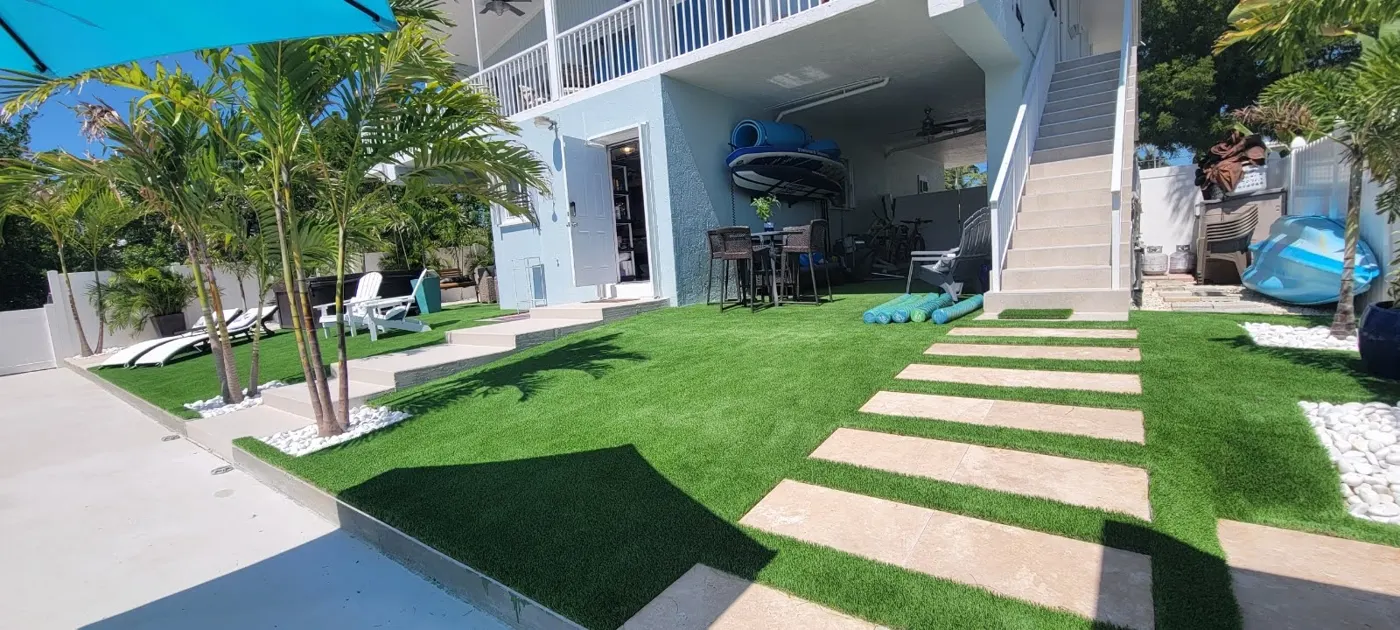
A front or backyard lawn has the opposite job: it has to look like a full natural lawn from the street and from the back door. At 1½ to 2 inches, the pile is tall enough to read as real grass, show the thatch layer — those short, curly tan fibers at the base that mimic a real lawn's depth — and keep the backing hidden between the stitch rows.
Taller is not automatically better, even here. Past the landscape range, pile holds more heat, mats faster under traffic, and needs more infill and brushing to keep standing. The plush hand-sample that wins on a showroom table is often the pile that lays over in a Florida backyard by its second summer. Density — face weight, the yarn you actually walk on — does more for a lasting full look than extra height ever will. AJ Turf quotes both face weight and total weight for exactly that reason: a heavy backing can make a sparse turf weigh like a dense one, and height plus a big total-weight number can hide a thin lawn.
How pile height interacts with everything else
- Infill: Infill is structural — it supports the blades so they stand. A taller pile needs its infill at spec (AJ Turf's baseline is 1.5–2 lb per square foot) or it will lean and mat no matter how good the yarn is. The finished-install check is simple: fibers standing straight, infill spread evenly, no bare or sand-choked spots.
- Blade shape: Height is only half of how a lawn stands. Blade cross-sections — C, W, Omega, and the rest — trade resilience against softness and realism. A resilient blade shape at 1½ inches will out-stand a soft flat blade at 2 inches in a traffic lane.
- Traffic: High-traffic lanes punish tall, soft pile first. Where kids, dogs, and footpaths concentrate, the lower end of the landscape range — or a pet-range product for a true dog run — is the honest spec.
Florida note
Florida argues for the disciplined end of every range. Heat is the reason: a taller pile presents more fiber to the sun and holds heat in the surface, and Southwest Florida sun in Fort Myers, Cape Coral, Naples, Estero, Bonita Springs, Sanibel, and Lehigh Acres is not a mild test. Shorter, correct-for-the-use pile dries faster after summer storms, cleans up easier in pet areas, and mats less in the humidity. When heat is a deciding factor, the named options are spec'd at the system level — for example, TCool, a bagged precoated-sand cooling infill that cools by evaporation while it is hydrated, applied as its own layer at ½–1 lb per square foot — rather than by choosing a taller lawn and hoping.
The honest downside Every range gives something up. A pet-height lawn will never look as lush as a 2-inch landscape lawn — it is not supposed to. A landscape-height lawn is more work in a dog area and a worse cleanup surface, forever. And a putting green at ⅜–½ inch is a purpose-built surface: it rolls a ball beautifully and looks like a green, not a yard. There is no single pile height that is best at all three jobs, and any quote that specs one product at one height for your lawn, your dog run, and your green is simplifying your yard for its own convenience.
The gotcha The bait is height sold as quality: "our premium 2-inch pile" presented as if taller automatically means better turf. Height is the easiest number to feel in a sample and one of the least informative numbers on a spec sheet. Ask for the two numbers that actually describe density — face weight and total weight, both of them — and ask why the quoted height fits your use: lawn, dogs, or golf. If the answer is "it's our premium," you have learned the height of the sales pitch, not the turf.
How AJ Turf handles this
AJ Turf specs pile height by area, on site: landscape lawns in the 1½–2 inch range, pet areas at 1–1¼ inches built as a full pet system — high-flow backing, ZeoFill (a zeolite odor layer at 1.5 lb per square foot for a dog up to 45 lb, 2 lb for a 50–65 lb dog, and 3–4 lb for multiple or large dogs) or Envirofill by Motz, an antimicrobial-coated sand, at the standard 1.5–2 lb per square foot where coated sand is the better fit — and putting greens at ⅜–½ inch with greens infill in the 30/50 grade, #60 at the fine end, and lab-measured roll data published with test conditions instead of a promised target.
Underneath every height is the same AJ Method: dig about 2–3 inches below the sod line, screening-sand base compacted to 95% Standard Proctor (ASTM D698) per Synthetic Turf Council guidance, woven weed barrier on top of the base, turf glued to a 3×3×3-inch concrete border with no spikes through the turf, and pile direction set on purpose — toward the house in backyards, toward the street in front yards, because turf is directional and the lean is the face your yard shows the world.
Most installs run $9–$15 per square foot depending on the turf and the site; the exact price comes only from a free onsite quote. Installs are a minimum of 1,000 square feet and typically scheduled within two weeks; deposits are 30% to schedule, 35% on the first day on site, and 35% on completion, always non-refundable. Turf carries the manufacturer's warranty for the product you choose — 8, 16, or 25 years, UV stability and strength only, prorated, non-transferable — plus AJ Turf's 1-year labor warranty. AJ Turf also prepares and submits your HOA application on your behalf.
Questions people ask.
Can I use one pile height for my whole yard, dogs included?
You can, and it is usually a compromise you feel daily. Landscape-height pile in the dog's area is harder to clean, dries slower, and carries more odor risk; pet-height pile across the whole lawn looks noticeably less lush. Spec'ing each area to its use — which can mean two products in one yard — is the build that performs.
Does a taller pile need more infill?
Generally, yes — infill is what holds tall blades upright, and it has to be at spec for the height to stand instead of laying over. AJ Turf's baseline is 1.5–2 lb per square foot, and the finished check is fibers standing straight with infill spread evenly. A tall pile quoted with light infill is a matting problem scheduled in advance.
Why are putting greens so much shorter than lawns?
Because the ball has to roll on top of the surface. A green's short, dense, texturized fiber at ⅜–½ inch, tuned with fine greens infill, is what produces a true roll. A lawn-height pile swallows the ball. They are different surfaces built for different physics, not the same turf cut to different lengths.
My sample feels plush and tall. Should I pick it for my backyard?
Feel in a hand sample tells you softness, not how the yard will stand, drain, or clean in year two. In Florida, the upper end of the landscape range holds more heat and mats faster in traffic lanes. Judge the sample by its spec sheet — pile height in range, face weight and total weight both stated — and by whether that height fits how the area will actually be used.
Updated 2026-10-13
