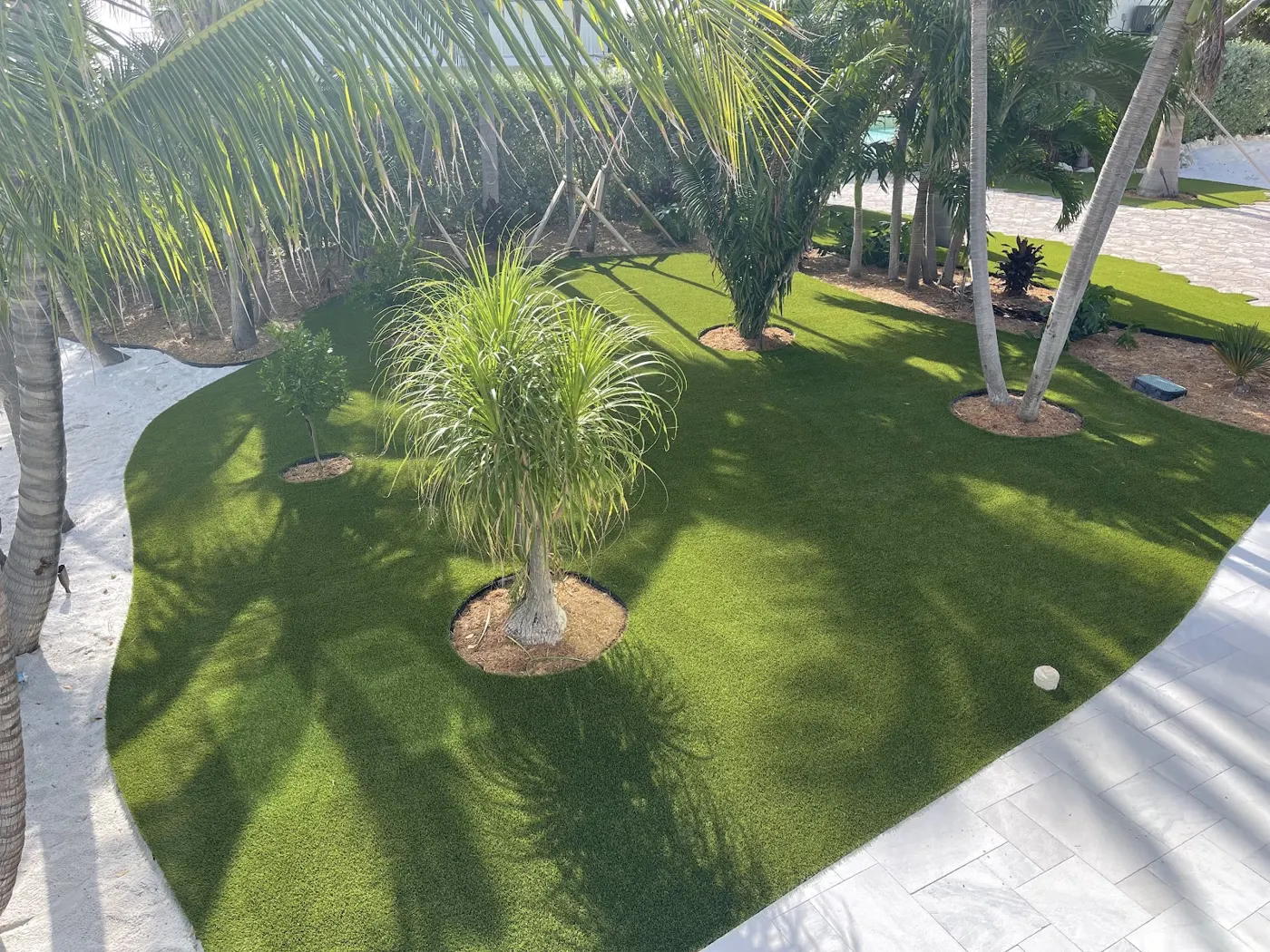
The short answer
Artificial turf needs less than grass, not nothing: remove debris and solids, rinse periodically — more often where dogs go — brush against the grain to keep blades standing (weekly in traffic lanes, monthly elsewhere), check and top up infill, and book a professional inspection and deep clean at least once a year.
The short version — the owner's checklist
| When | The job | Why |
|---|---|---|
| As it lands | Remove debris; pick up pet solids promptly | Debris sitting in the pile feeds surface growth and odor |
| Weekly | Brush high-traffic areas against the grain; rinse pet areas | Brushing restores erectness; rinsing is the standing routine where dogs go |
| Monthly | Brush low-traffic areas against the grain | Low-traffic pile still settles and needs cross-brushing |
| In dry spells | Rinse periodically — rain is the best cleanser, and dry spells remove it | Dust and light soil build up when no rain does the rinsing for you |
| Periodically | Check infill levels (the stiff-brush feel test); rake or brush to prevent infill compaction | Infill is structural — it supports the blades |
| About every 18 months | Top infill up to the manufacturer's quantity and type, as needed | Infill migrates and compacts in traffic lanes over time |
| At least annually | Professional maintenance: inspection and deep clean | The manufacturer's own recommendation — problems get caught while they're small |
What disappears — and what doesn't
The big list genuinely goes away: no mowing, no watering, no fertilizing, no overseeding, and no pesticides — ever. That's the honest headline, and it's most of why people buy turf.
What remains is smaller, but it is a real list. Turf is a surface that lives outdoors in Florida, and it collects what any outdoor surface collects: debris, dust, pet waste, and traffic patterns. The maintenance below is the difference between a yard that looks installed-last-month for years and a yard that slowly goes flat, patchy, and tired.
The routine, task by task
Rinsing. Rain is the best cleanser turf has. In dry spells, rinse periodically. Light soil comes off with a solution of 5% low-sudsing detergent in hot water, applied with a sponge mop and followed by a hot rinse; heavier soil gets a repeat of that treatment, then a 3% household ammonia solution and another hot rinse. Waterborne stains respond to about a teaspoon of mild detergent per pint of water. In pet areas, rinsing is not occasional — it's the routine: remove solids promptly and hose down where the dogs actually go, regularly.
Brushing. Fibers flatten where feet, paws, and furniture press them. Brushing against the grain restores erectness — weekly in high-traffic areas, monthly in low-traffic ones. Matting in traffic lanes is managed the same way, with periodic cross-brushing. Use synthetic bristles only: never a metal rake and never a wire- or metal-bristle brush.
Infill care. Infill is not decoration — it gives the fibers the support to stand up straight, and a finished install carries at least 1.5 lb per square foot of it. Check levels periodically, rake or brush to keep it from compacting, and top it up to the manufacturer's quantity and type when lanes run low — about every 18 months is the typical replenishment framing. Rotate heavy furniture instead of leaving it parked in one spot, redistribute the infill underneath it, and brush the area after you move it.
Stains and spots. Oil-based stains are the careful case: a perchlorethylene-type remover or mineral spirits, used sparingly on a soaked cloth — these solvents are flammable, and they should never be allowed to penetrate below the surface. When in doubt, stop and treat it as a cleaning question before it becomes a fiber question.
What never touches the turf
Three cleaner categories are off the list entirely: no chlorine bleach, no caustic cleaners above pH 9, and no highly acidic cleansers below pH 5. Keep fireworks and open flame away; cigarettes can't ignite turf, but they melt fibers on contact. No idling vehicles parked on it (heat), no sharp objects dragged across it, no heavy loads left sitting on it. And watch reflected sunlight: sun bouncing off windows, metal, or glass can concentrate enough heat to melt fibers — a real hazard, not a theoretical one.
Maintenance is a warranty issue, not just a looks issue
This is the part owners skip. The manufacturer's care guide is the guide the warranty expects you to follow — failure to maintain per the guidelines can void coverage, and improper cleaning and cleaning chemicals sit on the warranty exclusion list. So the checklist above isn't cosmetic advice: it's part of how you keep the coverage you paid for. The same logic covers repairs: report minor problems promptly, before they become major ones. Small tears can be patched with turf adhesive and spare turf per the manufacturer's instructions; larger damage is a professional repair.
Florida note
Florida loads every line of the checklist. Rain does your rinsing for months at a time — then the dry season takes it away, and periodic rinsing becomes your job again. Heat and humidity accelerate the bacteria behind pet odor all year, which is why pet-area rinsing here is a standing routine, not an occasional one. And the melt warning is a Florida warning: strong sun plus reflective windows and glass is a combination this state serves up daily. Debris discipline matters more here too — organic debris sitting in shaded, damp pile is exactly where surface growth starts.
The honest downside "Low maintenance" is not "no maintenance," and the gap between those two phrases is where owners get disappointed. The routine above is real: brushing, rinsing, infill checks, an occasional top-up, and a professional clean at least once a year, which is a cost on top of the install price. Pet yards ask the most — regular rinsing where the dogs go, forever. Skip the routine and the yard doesn't fail dramatically; it declines quietly — flat lanes, migrated infill, odor that builds in the base — and because the warranty expects the care guide to be followed, neglect can cost you coverage as well as looks.
The gotcha The pitch to listen for is "zero maintenance" — sometimes paired with a spray-on antimicrobial reapplication sold as a recurring service. Two tells: first, any installer who says zero is leaving the manufacturer's own care guide out of the conversation, and that guide is warranty-linked. Second, antimicrobial protection that's actually built into a turf's backing is mixed in during manufacturing — it doesn't rinse off and never needs reapplication. If someone wants to sell you a re-spray schedule for protection that was built in at the factory, you're paying rent on something you already own.
How AJ Turf handles this
AJ Turf finishes every install with a final groom, rinse, and walkthrough — and the walkthrough is where the routine above gets handed over in plain terms: how to brush, how to rinse, what never touches the turf. Our installs start with infill at the ruled baseline of 1.5–2 lb per square foot, because infill is structural — it's what holds the fibers upright between brushings. Where a product carries antimicrobial protection, it's the built-in kind — mixed into the backing at manufacture, never a reapplication we sell. And when maintenance turns into damage — a tear, a flat lane that won't brush back, infill that has washed out — repairs start with a free onsite assessment, with no minimum job size for repair work.
Questions people ask.
Do I ever need to water artificial turf?
Not to keep it alive — there's nothing alive to water. Rinsing is cleaning, not irrigation: rain does most of it, you rinse periodically in dry spells, and pet areas get rinsed regularly because that's the odor routine. In-ground irrigation is never used to irrigate the turf itself.
How often do I really have to brush it?
Weekly against the grain in high-traffic areas, monthly in low-traffic ones. That's the manufacturer's care-guide cadence, and it's what keeps traffic lanes from matting flat. Use a synthetic-bristle brush — never metal bristles or a metal rake.
When does infill need topping up?
Check levels periodically — a stiff-brush feel test tells you when lanes are running low — and top up to the manufacturer's quantity and type when they are. About every 18 months is the typical replenishment framing. Infill also needs redistributing after heavy furniture is moved.
Can I pressure-washer or bleach my turf clean?
Bleach is out entirely — chlorine bleach is on the never list, along with caustic cleaners above pH 9 and highly acidic cleansers below pH 5, and improper cleaning is a warranty exclusion. The care-guide route is milder and it works: low-sudsing detergent in hot water for light soil, a 3% household ammonia solution for heavy soil, always followed by a hot rinse.
Updated 2026-10-13
