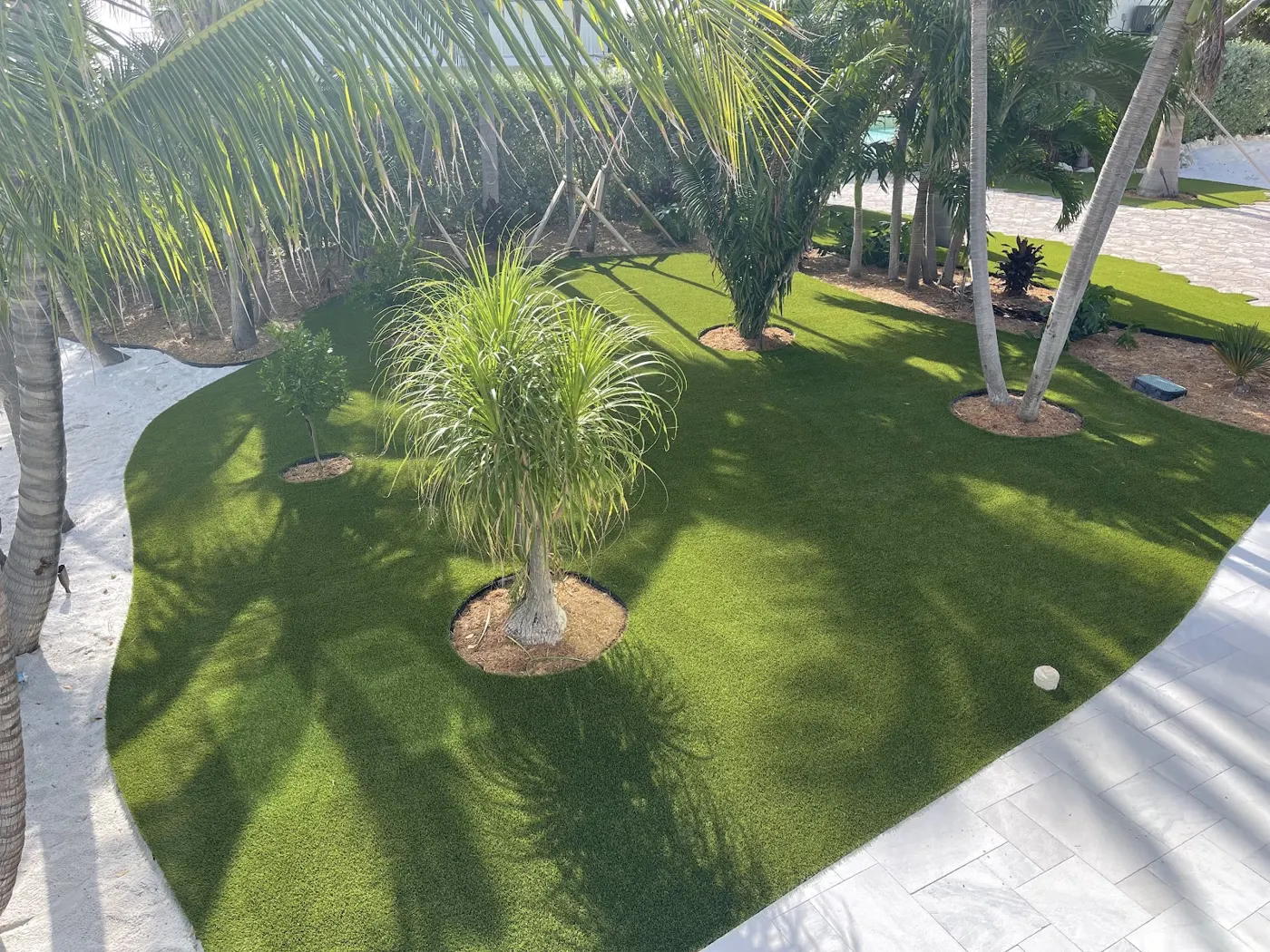
The short answer
Honestly, nobody knows a wind rating for a residential turf yard — no published test data backs any hurricane claim, and we will not invent one. What construction can do is remove the known weak point: edges. AJ Turf glues the perimeter to concrete and ballasts the surface with infill, instead of spiking edges into saturated sand.
The short version
| Question | The honest answer |
|---|---|
| Is there a hurricane wind rating for turf? | No — no published test data exists |
| What fails first in a storm? | Edges and seams |
| AJ Turf edge construction | Turf glued to a poured concrete border, full perimeter |
| Surface ballast | Infill at 1.5–2 lb per sq ft across the whole yard |
| What AJ Turf does NOT use through the turf | Spikes or nails — they secure only the barrier and seam tape underneath |
Start with what nobody can tell you
There is no hurricane performance standard, wind-uplift rating, or published test result for a residential artificial turf installation. Not for our installs, not for anyone's. Florida's statewide turf rule requires that edges and seams be anchored, at minimum against wind and flooding — it requires the anchoring to hold, and it does not certify a wind speed, publish a test, or rate any product for a storm.
So this page will not tell you turf is "hurricane-proof," "rated to" some number of miles per hour, or guaranteed to survive a named storm. No honest installer can. What can be discussed — carefully — is construction logic: how a yard is held down, and which way of holding it down makes more sense when the ground is saturated and the wind is pulling at the edges.
The construction logic
Wind doesn't usually take a whole yard at once. It works at edges and seams — the places a surface can be lifted, peeled, or shifted. That's why the anchoring method is the storm conversation.
Spikes in saturated sand. The standard industry method drives nails or spikes through the turf around the perimeter. Each spike is a single point of hold in the ground — and in Southwest Florida the ground is sand. Saturated sand holds a spike worse than dry sand, spikes already work loose under normal thermal cycling and foot traffic, and a spike that pulls out of turf is a failure point and a hazard in ordinary weather. In a storm, a spiked perimeter is a row of individual points waiting for the weakest one to let go.
A glued continuous perimeter. The AJ Method pours a 3×3×3-inch concrete border around the full inside perimeter and glues the turf edges to it with turf glue carrying a 15-year warranty. No spikes or nails ever go through the turf — they secure only the woven weed barrier and the seam tape underneath it. The edge stress is distributed along a continuous bonded border instead of concentrated on points driven into sand.
Infill ballast. On top of that, the whole surface carries infill at 1.5–2 lb per square foot, brushed in against the grain. Across a yard, that is a substantial, evenly distributed weight holding the surface down — ballast a spiked, lightly infilled install doesn't have.
Put together: a glued continuous perimeter plus full infill ballast is a materially better wind-uplift story than spikes in saturated sand. That is a statement about construction, not a performance claim — and it's as far as the evidence honestly goes.
The other storm: water
Hurricanes in Southwest Florida are as much a water event as a wind event. The turf system is built to drain: a screening-sand base compacted to 95% Standard Proctor (ASTM D698), subgrade graded for positive drainage, and permeable turf over the top. Florida's rule also carries the guardrails — no pooling or increased stormwater runoff to neighboring properties, and a 10-foot setback from any waterbody unless a physical barrier like a seawall exists. A yard built that way is designed to shed and drain storm water through the system rather than hold it on the surface. Flooding beyond the system's design — storm surge, a yard under standing water — is a different event, and no drainage design claims to defeat it.
Florida note
Hurricane season runs June 1 through November 30, and it's the season this construction logic exists for: saturated sand is the normal condition of a Southwest Florida yard in a storm, not an edge case. It's also why installs pause around storms — and why post-storm damage is one of the things that drives repair calls in the fall. If a storm does lift an edge, open a seam, or shift a panel on any install, that's repair work: seams can be re-glued on tape, edges re-bonded, and panels re-set — starting with a free onsite assessment.
The honest downside Turf is not warranted against hurricanes, full stop. Acts of God are excluded from the manufacturer's warranty, and AJ Turf's 1-year labor warranty is not storm insurance either. A major storm can damage a well-built yard — flying debris, fallen trees, surge, and flooding don't respect construction methods — and storm damage is a repair bill, not a warranty claim. If your buying decision needs a guaranteed storm outcome, no turf product can honestly give you one.
The gotcha "Hurricane-rated" turf. There is no such rating — no test, no standard, no published data behind the phrase wherever you see it advertised. It's the storm-season version of every other invented number in this industry. When an installer leans on hurricane claims, ask one question: "Rated by whom, tested how, and where's the data?" There won't be an answer, because there isn't one. Judge the construction instead: how are the edges held down, and what's the ballast?
How AJ Turf handles this
AJ Turf builds the storm case into the standard method rather than selling it as an upgrade: a poured 3×3×3-inch concrete border around the full perimeter with the turf glued to it, seams joined on tape with glue underneath the turf, no spikes or nails through the turf ever, and infill ballasted at 1.5–2 lb per square foot. The method is built around Florida's statewide synthetic turf standard (Rule 62-308.100), including anchored edges and seams, positive drainage, and the 10-foot waterbody setback. After a storm, turf repair starts with a free onsite assessment and there's no minimum job size for repairs.
Questions people ask.
Is artificial turf hurricane-proof?
No, and no installer can honestly claim otherwise. There is no wind rating or published test data for residential turf in a hurricane. What's controllable is construction: glued continuous edges and infill ballast instead of spikes in saturated sand.
What part of a turf yard fails first in a storm?
The edges and seams — they're where wind gets under a surface and where water undermines a perimeter. That's exactly why the anchoring method matters more than any claim about the turf product itself.
Does the turf warranty cover hurricane damage?
No. Acts of God are excluded from the manufacturer's warranty, which covers UV stability and strength of the product. AJ Turf's warranty is a 1-year labor warranty on the installation. Storm damage is handled as repair work.
My turf lifted at one edge after a storm. Does the whole yard need replacing?
Usually not. Edge lifting is one of the standard repair shapes: the edge can be re-bonded to the border, seams re-glued, and panels re-set. Repairs start with a free onsite assessment, and there's no minimum job size.
Updated 2026-10-13
