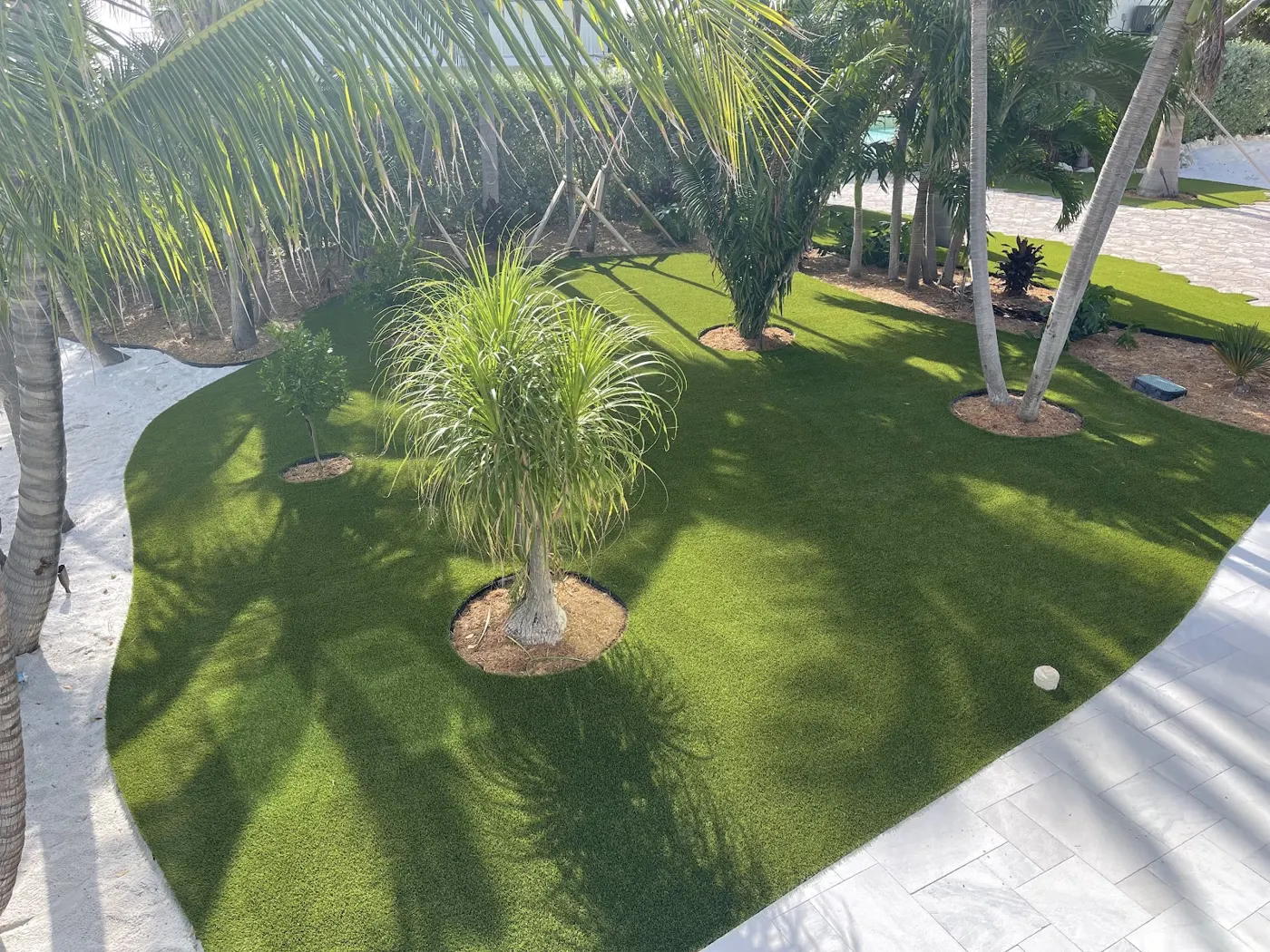
The short answer
Yes — turf can be removed and a yard can go back to real grass, but it is a removal job, not a roll-it-up afternoon: turf, infill, barrier, sand base, and the concrete border come out. The key is preservation at install — AJ Turf caps sprinkler heads in place instead of ripping them out, so the irrigation system survives.
The short version
| Layer (top to bottom) | What happens to it on removal |
|---|---|
| Turf + infill | Lifted and hauled out; infill (1.5–2 lb per sq ft of it) goes with it |
| Woven weed barrier | Pulled up from on top of the base |
| Screening-sand base | Removed or worked over — it is a base, not topsoil for new sod |
| Concrete border (3×3×3″) | Broken out — it's a poured perimeter, not a loose edge |
| Sprinkler system | Still there: heads were capped in place, never ripped out |
What "removing turf" actually means, layer by layer
Artificial turf isn't a rug laid on your lawn. It's a built system, and taking a yard back to grass means unbuilding it in reverse order.
Start at the top. The turf itself is seamed — pieces joined on seam tape with glue — and its edges are glued to the concrete border, so removal is cutting and lifting a bonded surface, not rolling up a loose sheet. Under the blades sits the infill: at the standard 1.5–2 lb per square foot, a 1,000-square-foot yard holds roughly a ton or more of material that has to come out with the turf.
Under the turf is the woven weed barrier, which sits on top of the base and pulls up with the surface work. Under that is the base itself: screening sand, spread at about a ton per 100 square feet and compacted hard. That layer is the real work of going back to grass. The yard was excavated 2–3 inches below the old sod line to build it, and the AJ Method is explicit that a base is never built on topsoil — the reverse is also true: new sod doesn't go straight onto a compacted sand base. The base has to be removed or worked over and the grade rebuilt before grass has a fair start.
And then there's the border: a poured 3×3×3-inch concrete perimeter. It's the strongest part of the install by design, and it's the least reversible — going back to grass means breaking it out.
The part that was preserved on purpose: your sprinklers
The single biggest reversibility decision happens on install day, and it's the sprinkler system. The common shortcut is to rip the heads and lines out of the turf area — gone is gone. AJ Turf's practice is the opposite: existing heads are capped and left in place, never ripped out, and the system stays intact underneath the yard.
That choice is also the compliant one. Florida's turf rule says in-ground irrigation can't be used to water synthetic turf areas, and it permits — but does not require — heads to be removed and pipe capped. Capping satisfies the rule and keeps the system alive: heads outside the turf footprint, in planting beds, stay live the whole time, and the capped heads inside the footprint are still there if the yard ever goes back to grass. It's the answer seasonal owners ask about most: if you sell, or if a future owner wants a lawn again, the irrigation wasn't destroyed to install the turf.
What going back to grass does not undo
Be clear-eyed about the rest. The excavation changed the grade — the yard sits 2–3 inches below where the old sod line was, with a compacted base in between. The old lawn itself is gone; "going back" means new sod or seed on a rebuilt surface, with everything a new Florida lawn demands — including the watering restrictions that apply to natural grass in Lee County and Cape Coral, which were probably part of why the turf went in. Removal returns the option of a lawn. It doesn't restore the old one.
Florida note
Reversibility matters more in Southwest Florida than most places because so many yards here are seasonal. Owners who are gone June through October want a yard that's perfect on arrival and needs nothing while they're away — and they ask, reasonably, what happens if they sell. The capped-sprinkler answer is the concrete one: the turf system can come out, and the irrigation a future lawn needs was never ripped out to put it in. A yard where the previous installer tore out the irrigation wholesale is a much more expensive yard to return to grass.
The honest downside Reversible is not the same as free, fast, or easy. Removal is a construction job in reverse — bonded turf, a ton-scale amount of infill and sand, and a poured concrete border to break out — and then the lawn itself has to be re-established from scratch on a rebuilt grade. If there's a real chance you'll want grass back in a year or two, that's worth weighing before you install, not after. And none of it is covered by any warranty: the manufacturer's warranty covers the turf product's UV stability and strength, and AJ Turf's 1-year labor warranty covers the installation — neither pays to take a yard back to grass.
The gotcha "It's totally reversible — just roll it up." That pitch only works if you never ask what the turf is attached to. Turf glued to a concrete border, seamed with tape and glue, over a compacted base, does not roll up. The honest version is this page: removable, yes — as a job, with the border and base as the work. When an installer promises effortless reversibility, ask what happens to the border and the base in their version. If there's no answer, there's no plan.
How AJ Turf handles this
AJ Turf builds with the exit in mind from day one: sprinkler heads are capped and left in place, never ripped out, so the irrigation system stays intact under every install. The rest of the method is stated plainly so you know exactly what a future removal involves — turf glued to a 3×3×3-inch concrete border, a woven weed barrier on top of a screening-sand base compacted to 95% Standard Proctor (ASTM D698), and infill at 1.5–2 lb per square foot. Nothing about the build is hidden, and nothing about removing it is oversold. New installs run $9–$15 per square foot for most jobs, start at 1,000 square feet, and the exact price comes only from the free onsite estimate.
Questions people ask.
Can artificial turf be removed without destroying the yard?
It can be removed, and the yard can be rebuilt for grass — but removal is real work: the bonded turf and infill come out, the barrier comes up, the compacted sand base is removed or worked over, and the concrete border is broken out. "Without destroying" depends on the sprinklers — capped-in-place systems survive; ripped-out systems don't.
Will my sprinkler system still work if I go back to grass?
On an AJ Turf install, the system was never removed: heads in the turf area were capped and left in place, and heads in planting beds stayed live. Going back to grass means uncapping and checking those heads, not reinstalling an irrigation system from zero.
Can I remove just part of the turf and keep the rest?
Partial removal runs into the same construction: the turf is seamed and glued to a continuous border, so cutting out a section means cutting seams and border and re-finishing the edge of what stays. It's possible as a scoped job — it's just not a snip-and-lift. Get it looked at on site before assuming either way.
Does removing turf and re-sodding cost as much as the install did?
There's no honest per-square-foot number for it without seeing the yard — removal scope, base depth, border length, and what the new lawn needs all vary. What can be said up front: it's a construction job in both directions, not a free undo, and it should be quoted from an onsite look, not a phone guess.
Updated 2026-10-13
